
Kafka Queues: Share Groups Explained
Kafka share groups are a consumption model introduced in KIP-932 that lets many consumers cooperatively read one topic with per-record acknowledgement, so multiple members can process records from the same partition at once.
This solves a long-standing Kafka limitation by decoupling consumer parallelism from partition count, bringing queue-like semantics to Apache Kafka without changing the underlying partitioned log.
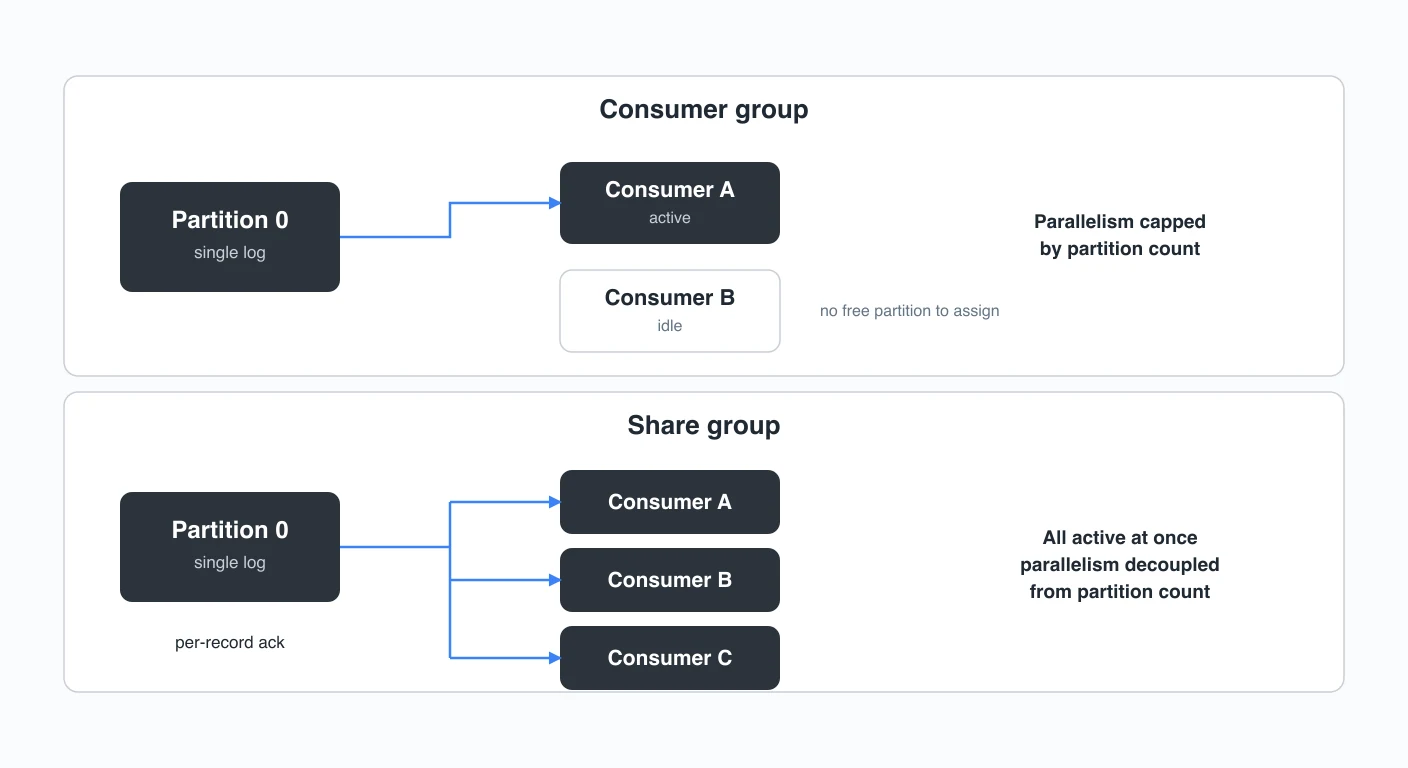
What are Kafka share groups?
A classic consumer group binds each partition to exactly one member at a time. Concurrency is therefore capped at the partition count: ten consumers on a six-partition topic leave four idle. Raising throughput has historically meant adding partitions, which can have negative consequences for the cluster.
Share groups remove that coupling. A share group is a named set of consumers/workers where multiple members can process records from the same partition concurrently, and each record is acknowledged individually rather than by advancing a partition offset. The broker distributes records, tracks their state, and reclaims any that are not acknowledged in time to redistribute them to other workers. This effectively gives a shared work queue on top of the Kafka log, with two consequences:
- Parallelism is no longer tied to partition count. A share group can have more active members than the topic has partitions.
- Failed records can be redelivered or discarded per record, without stalling the rest of the stream (avoiding head-of-line blocking).
Share groups vs consumer groups
| Dimension | Classic consumer group | Share group |
|---|---|---|
| Partition sharing | One consumer per partition | Many consumers per partition |
| Parallelism ceiling | Number of partitions | Independent of partition count |
| Acknowledgement | Offset commit (high-water mark) | Per record: accept / release / reject |
| Ordering | Guaranteed within a partition | Within a delivered batch only; none across batches or members |
| Redelivery | Rewind offset (whole group) | Per record, up to a delivery-attempt limit |
| Assignor | Client- or server-driven | Share-partition assignor (server-driven) |
| Best fit | Ordered streams, high throughput | Job/task queues, slow I/O, AI agents ⭐ |
How per-message acknowledgement works
Instead of committing an offset, a share consumer resolves each record individually. Three outcomes:
- ACCEPT: the record was processed successfully; it's marked acknowledged and will never be redelivered.
- RELEASE: the consumer cannot process it right now (a transient failure); the record is redelivered to another consumer.
- REJECT: the record is unprocessable (e.g. an unexpected payload or a critical error); it is archived with no further attempts.
A consumer that needs more time (slow I/O, high latency, LLM calls...) can also RENEW the acquisition lock to extend processing without releasing the record.
Each record moves through a small state machine per share group: Available → Acquired → Acknowledged (ACCEPT), or back to Available (RELEASE), or to Archived (REJECT, or once retries are exhausted).
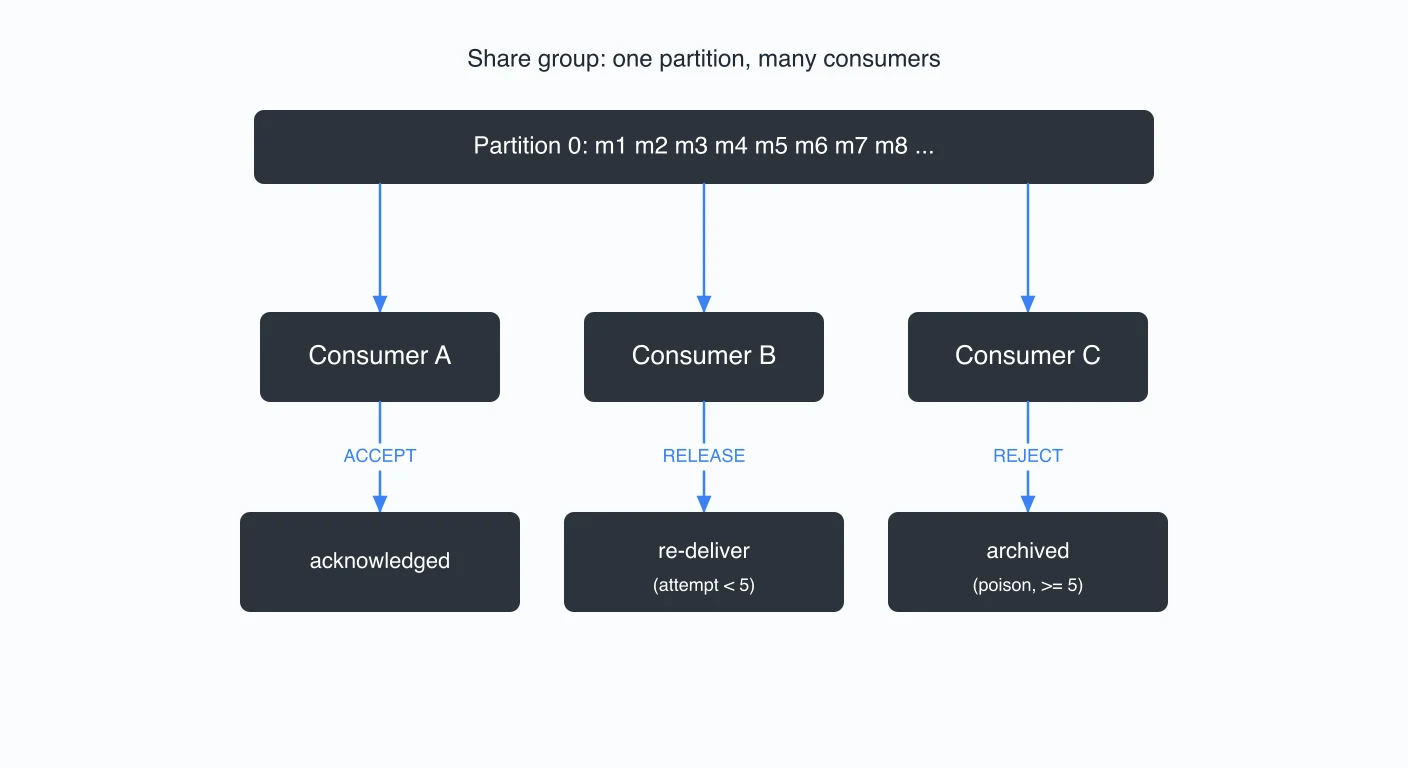
When a consumer acquires a record it holds an acquisition lock for share.record.lock.duration.ms (default 30s). If the record is not acknowledged before the lock expires (a crash, a hang, a slow downstream call) it automatically returns to Available for redelivery.
There is also built-in protection against poison-pill messages. Every acquisition increments a delivery count; when it reaches group.share.delivery.count.limit (default 5) the record is archived and no longer delivered, so a single bad record cannot loop forever.
When share groups help
Share groups help most when the bottleneck is the consumer itself:
- I/O-bound work. Each record triggers a slow external call: an HTTP request, a database write, an LLM inference. Consumers spend most of their time waiting, so adding more of them raises effective throughput even on a single partition.
- More consumers than partitions. You want 50 workers but the topic has 6 partitions. A share group admits all 50 without repartitioning.
- Head-of-line blocking. In a classic group, one slow record blocks its partition. With per-record acquisition, other members keep draining while the slow one is retried or archived.
- Job and task queues. Workloads that would otherwise force over-partitioning purely to raise concurrency map cleanly onto a share group.
- AI agents and multi-agent systems. A single agent step is an LLM call or tool invocation measured in seconds, not milliseconds, so a stream of agent tasks is dominated by consumer wait time rather than broker throughput. When an orchestrator fans work out to specialized sub-agents over Kafka, a share group runs far more agent workers than the topic has partitions, and per-record acknowledgement retries a slow or failed step (an inference timeout, a provider rate limit) without stalling the rest. That makes Kafka a natural backbone for multi-agent workloads, where the bottleneck is model latency, not the log.
When share groups do not help
- Ordered per-key processing. CDC and any state machine that depends on strict in-partition order need a classic consumer group. Share groups give no ordering across batches, members, or redeliveries.
- Event-driven architecture and event sourcing. Ordering is critical: entity events must be processed in order (create, then update) to form a deterministic state. A share group instead splits records among its members like a work queue and acknowledges them one at a time, so no single member sees the whole ordered stream.
- Raw maximum throughput. For firehose pipelines where consumers are already CPU- or network-saturated, classic consumer groups with large fetch batches and sequential I/O win. Per-record acknowledgement and lock tracking add overhead that pure throughput workloads don't want to pay.
- Exactly-once transactional chains. The mature transactional/EOS tooling is built around offset commits, not share-group acknowledgement.
Status, versions, and enabling share groups
Share groups have followed a staged rollout:
- Kafka 4.0: Early Access, test-only, not upgradeable, wire format not stable.
- Kafka 4.1: Preview (not wire-compatible with the 4.0 early access).
- Kafka 4.2: production-ready / GA.
kafka-features.sh --bootstrap-server localhost:9092 describe | grep share
# Feature: share.version  SupportedMinVersion: 0  SupportedMaxVersion: 1  FinalizedVersionLevel: 1
The share rebalance protocol has to be turned on: group.coordinator.rebalance.protocols must list share. This applies to every cluster, single-broker or not. Without it, share consumers join but receive empty assignments (and therefore zero records):
group.coordinator.rebalance.protocols=classic,consumer,shareShare-group state (locks, delivery counts, start offset) lives in a new internal topic __share_group_state, managed by a share coordinator. That topic carries its own replication settings:
share.coordinator.state.topic.replication.factor=3 # Set to 1 if single broker in dev
share.coordinator.state.topic.min.isr=2 # Set to 1 if single broker in dev
There is a new Java API: class KafkaShareConsumer (not your classic KafkaConsumer) and the CLI adds kafka-console-share-consumer.sh for consuming and kafka-share-groups.sh (--list, --describe, --members, --state) for administration.
Kafka queues vs MQ alternatives
Share groups add queue semantics, but they are not a drop-in RabbitMQ or ActiveMQ Artemis replacement. Kafka still has many gaps:
- No built-in dead-letter queue.
- No delayed or backoff retry.
- Log-retention model, not queue-drain.
So share groups are best understood as queue-like consumption over a durable log, closing the biggest gap that pushed teams toward a separate broker (see Kafka vs RabbitMQ) without adopting RabbitMQ's full feature surface. Tools like Conduktor sit alongside the native CLIs to give operators visibility into share-group state, member assignments, and redelivery behavior across environments.
Do share groups replace consumer groups?
No. They are an additional consumption model for queue-like, unordered work. Ordered per-key streams, high-throughput pipelines, and exactly-once chains still use classic consumer groups.
Can more consumers than partitions be active in a share group?
Yes. That is the point: parallelism is decoupled from partition count, so a share group can run more members than the topic has partitions, all sharing the same partitions.
Are share groups production-ready?
They are GA in Apache Kafka 4.2, gated by the share.version feature flag (finalized to level 1 by default). They were Early Access in 4.0 and Preview in 4.1.
What happens to a record that keeps failing?
Each delivery increments a count; once it hits the limit (default 5, group.share.delivery.count.limit) the record is archived and never redelivered. There is no built-in dead-letter queue yet.
Do share groups guarantee ordering?
Only within a single delivered batch for a share-partition. There is no ordering guarantee across batches, across members, or across redeliveries.
Is Kafka a message queue?
Not by default: a topic is a retained, replayable log, and records are not deleted on read. Share groups (KIP-932) add queue-like consumption on top (per-record acknowledgement, many consumers per partition), so Kafka can serve queue workloads while staying a log. See Kafka vs RabbitMQ.
What is the difference between a Kafka topic and a queue?
A topic is a durable log that many consumer groups each read in full and can replay; a traditional queue distributes each message to one worker and drops it on ack. A share group adds queue-style distribution over a topic, but the log underneath stays retained and replayable.
Related Pages
- Kafka Consumer Groups Explained: the classic one-consumer-per-partition model share groups extend.
- Kafka Partitions Explained: why partition count historically capped consumer parallelism.
- Kafka Topics Explained: the durable log that share groups consume from.
- Kafka vs RabbitMQ: how log-based streaming compares to a traditional message queue.
- Dead Letter Queues for Error Handling: the DLQ pattern share groups still leave to the application.
Sources
- KIP-932: Queues for Kafka (Apache Kafka wiki)
- Queues for Kafka (KIP-932), Preview Release Notes+-+Preview+Release+Notes)
- Apache Kafka 4.2 Group Configs (share.auto.offset.reset, share.isolation.level)
- KafkaShareConsumer API (Apache Kafka Javadoc)
- Let's Take a Look at KIP-932: Queues for Kafka! (Gunnar Morling)
- Configure Share Groups for Docker in Confluent Platform