
AKHQ vs Paid Kafka Management Tools: When to Upgrade

A platform team installs AKHQ so developers can browse topics without a shell on the brokers. It's one container under Apache 2.0, and for a long time it does the job well.
Then more teams start using the cluster. Every request to read another team's topic now means AKHQ access for the people and a Kafka ACL for the application, and both go to the platform team, which doesn't own the data. The UI stays free; the platform team becomes the approval queue.
Paying for a Kafka UI makes sense when you need lag alerts with history, access requests the data owner approves, a complete audit log, or a vendor to call about a vulnerability. Without those needs, AKHQ stays a sound choice.
How AKHQ compares with two commercial Kafka UIs that have a free tier:
| AKHQ | Kpow | Conduktor Console | |
|---|---|---|---|
| License | Apache 2.0 | Commercial, free Community edition | Commercial, free Community Edition |
| Free tier limits | None, you run it | Up to 3 clusters and 10 users | Up to 50 users and 3 clusters |
| Who can do what | IdP groups mapped to roles and topic patterns in AKHQ's config file | RBAC in a YAML file (Enterprise) | Permissions per topic, group, subject and connector, in the UI, API or CLI |
| Kafka ACLs | Listed, read-only | Created and edited in the UI | Created and edited in the UI |
| Access requests | None | None; staged changes wait for a Kpow admin (Enterprise) | The owning team approves; access applied in Console and in Kafka (paid plans) |
| Lag history | Current values | The last hour or so, kept in Kafka topics | Last hour on Community, history on paid plans |
| Alerting | None | Through Prometheus and Alertmanager (Enterprise) | Built in, to Slack, Teams, email or a webhook (paid plans) |
| Audit log | Changes only, written to a Kafka topic, off by default | Full audit log (Enterprise) | Changes and topic browsing, searchable in the UI (paid plans) |
| Masking on screen | Yes, the same rules for every user | Data policies (Enterprise) | Paid plans |
| Support | Community, through GitHub | Priority support (Enterprise) | Standard Support on Team Edition; SLA on Enterprise |
What AKHQ already does well
AKHQ connects to several clusters, manages Kafka Connect and ksqlDB, and logs users in through LDAP, OIDC, GitHub or headers from a reverse proxy. It has group-based roles and masks fields on its own screen.
It runs as one container with no database, so there's nothing to back up when you upgrade it, and the project ships regular releases (0.28.0 in August 2026). For a platform team whose developers browse topics, reset offsets and restart connectors, a paid tool adds little.
AKHQ roles cover people, and Kafka ACLs cover applications
AKHQ decides what a user may do inside AKHQ. A role lists actions, an AKHQ group binds roles to topic patterns, and your LDAP or OIDC groups map onto AKHQ groups, all in its configuration file:
akhq:
  security:
    roles:
      topic-reader:
        - resources: [ "TOPIC", "TOPIC_DATA" ]
          actions: [ "READ" ]
    groups:
      payments-readers:
        - role: topic-reader
          patterns: [ 'payments\.transactions' ]
    ldap:
      groups:
        - name: analytics-team
          groups:
            - payments-readers
That covers the analytics team's people. Kafka checks something else: the ACLs attached to the principal an application connects with. AKHQ lists ACLs but can't create or change them, so the analytics team's service account gets its own entries from the Kafka CLI, Terraform or a Strimzi KafkaUser:
$ kafka-acls.sh --bootstrap-server localhost:9092 --add \
    --allow-principal User:analytics-app --consumer \
    --topic payments.transactions --group analytics-app
Adding ACLs for resource `ResourcePattern(resourceType=GROUP, name=analytics-app, patternType=LITERAL)`:
 	(principal=User:analytics-app, host=*, operation=READ, permissionType=ALLOW)

Adding ACLs for resource `ResourcePattern(resourceType=TOPIC, name=payments.transactions, patternType=LITERAL)`:
 	(principal=User:analytics-app, host=*, operation=DESCRIBE, permissionType=ALLOW)
	(principal=User:analytics-app, host=*, operation=READ, permissionType=ALLOW)
Nothing keeps the two lists in line. One platform team running AKHQ described the result to us: one set of identity groups for its Kafka platform, a second set for AKHQ, and no one-to-one mapping between them, so every team it onboards gets both.
With AKHQ, both changes land on the platform team. With federated ownership in Conduktor Console, the request goes to the team that owns the topic:
That's manageable with three teams. With thirty, every application that wants another team's topic needs an ACL change from whoever manages ACLs, usually the platform team, while the owning team knows better whether to grant it.
Kpow creates and edits Kafka ACLs from its own UI. In Kpow Enterprise, multi-tenancy limits what each team sees, and a staged change waits for a Kpow admin, usually on the platform team.
Lag alerts and history need a second stack next to AKHQ
AKHQ shows each partition's consumer lag when you open the group. It computes the number on request and doesn't keep it over time or send alerts.
For history and alerts next to AKHQ, you run an exporter such as KMinion or Burrow (compared in the best tools for monitoring consumer lag), Prometheus and Alertmanager. The three tools need a different number of components between the lag number and your channel:
Kpow keeps lag history for about the last hour in its own Kafka topics, and its alerts depend on a Prometheus you run.
Audit, masking and support decide the security review
Once you turn it on, AKHQ's audit writes changes to a Kafka topic: topics created or deleted, records produced, offsets reset, connectors restarted. It doesn't record who read which data, and the log is a Kafka topic you browse like any other. Check that against the security requirement before assuming a paid tool is needed.
Masking has the same reach in every UI: it hides a field from people in that UI, while applications reading Kafka get the full payload. Changing what applications read takes a proxy in the data path, such as Conduktor Gateway.
Support is the one requirement no feature covers. In a regulated company, an unlicensed tool in production draws questions from the security team, and an enterprise architect at a financial services company put it this way:
"I can reach out to you and ask you to get those fixed. With open source, who do I talk to?"
Enterprise architect, financial services company
AKHQ's support is its maintainers and community on GitHub, with no contracted response time.
What the free tiers and paid plans cost
Published prices as of November 2026:
| Option | Price | What it includes |
|---|---|---|
| AKHQ | Free | No limits; you run and patch it |
| Kpow Community | Free | 3 clusters, 10 users, no RBAC, masking, SSO or audit log |
| Kpow Enterprise | From $4,500 per cluster per year, 100 users included | Full feature set, priority support |
| Conduktor Community | Free | 50 users, 3 clusters, SSO, monitoring data for the last hour |
| Conduktor Team Edition | $1,200 per seat per year, or $125 per seat per month | Every paid Console feature, unlimited clusters, Standard Support by email for license, billing and configuration |
| Conduktor Enterprise | Contact sales | Custom contract, SLA, dedicated support team |
Conduktor Console routes access and alerts to the owning team
In Conduktor Console, each application owns its topics through federated ownership. Another team requests access from the Topic Catalog, and the owning team approves it in Console or through a pull request:
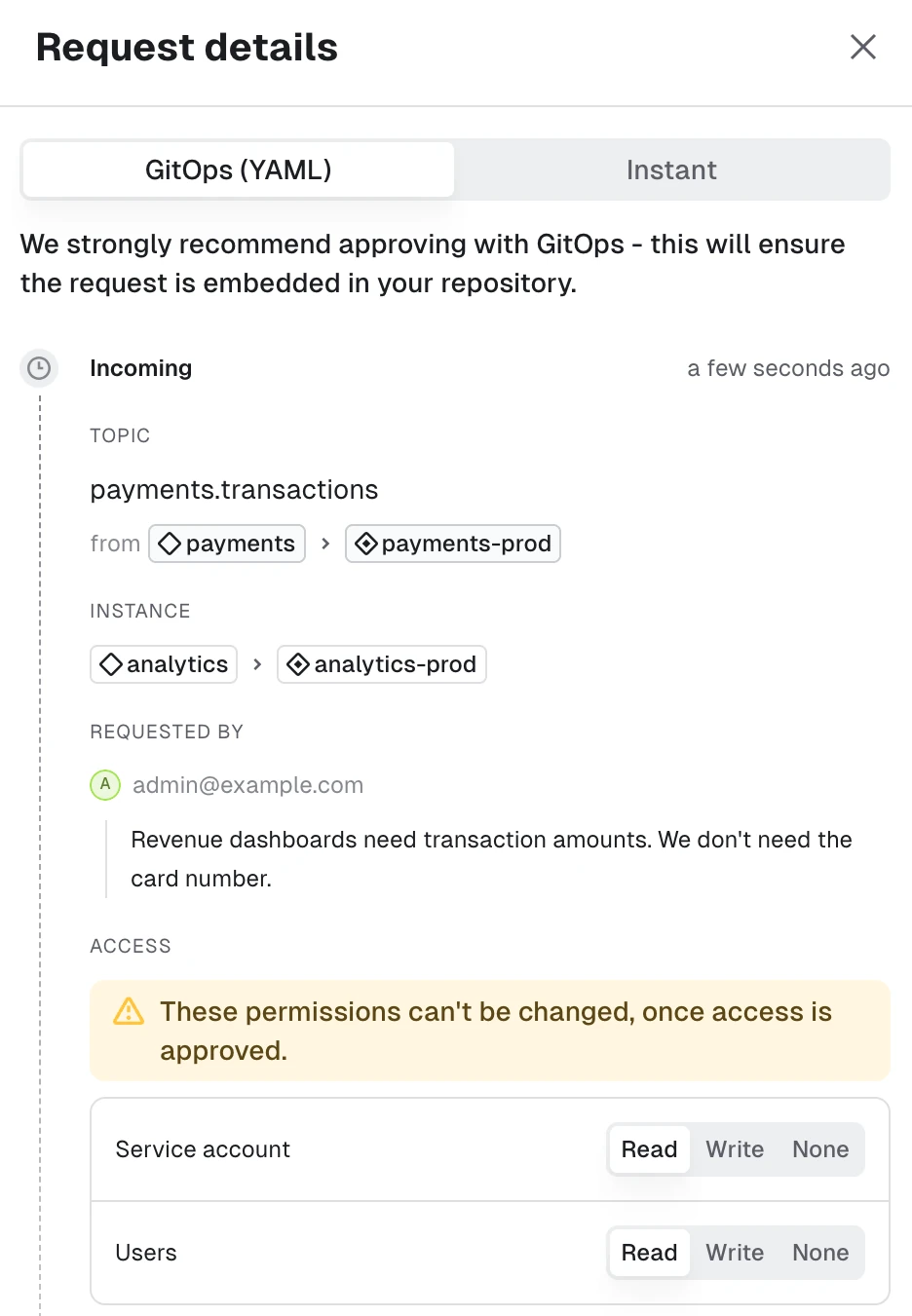
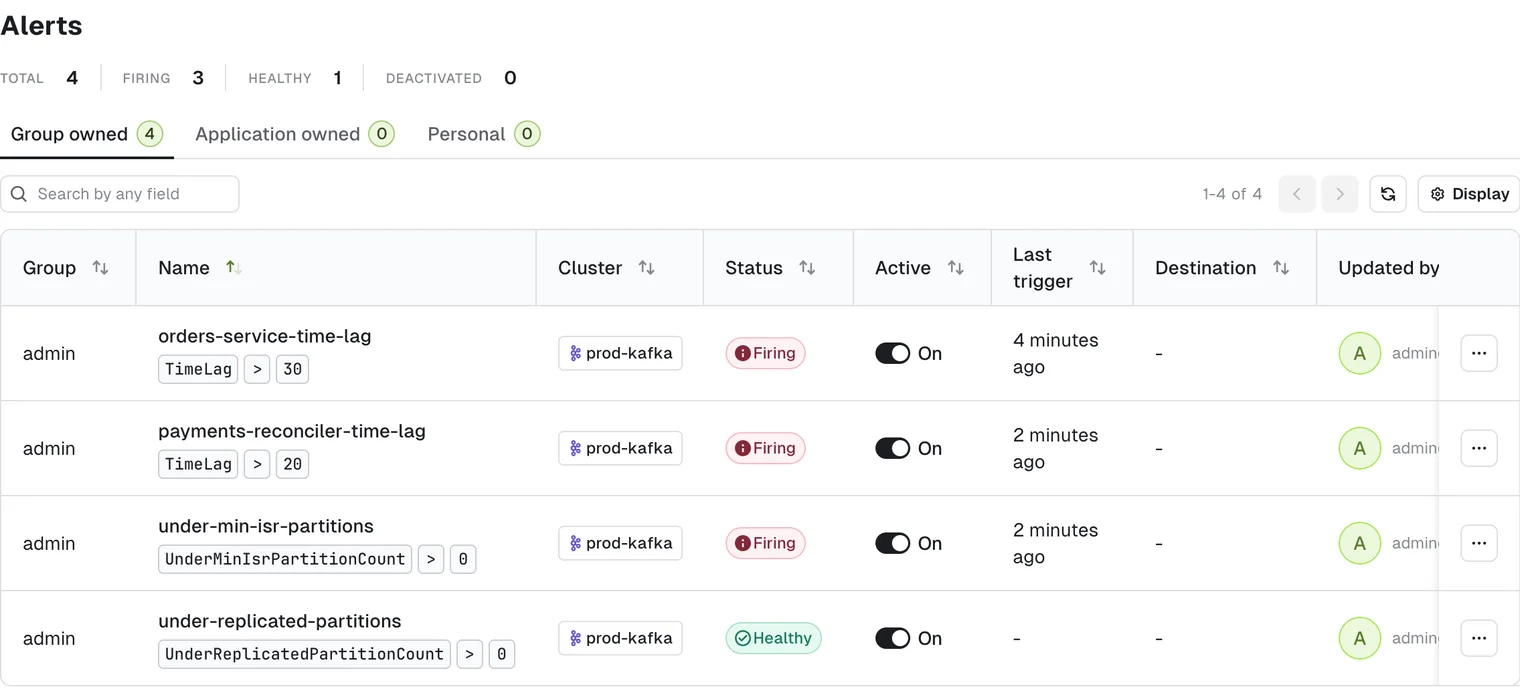
The platform team writes the rules once, as resource policies, and stays out of each approval. Alerts follow the same ownership: an alert belongs to a group, an application or a single user:
Matching the tool to how many teams share Kafka
Start from who will ask the platform team for access next, because that decides more than any screen:
- One platform team, a few developers, no alert requirement. Stay on AKHQ. It does the daily work, costs nothing and has no database to run.
- Many people on a few clusters, and one team running them. Kpow prices per cluster with 100 users included, edits ACLs from its UI and, on Enterprise, alerts through Prometheus.
- Security asks who changed what, and who to call about a CVE. Check AKHQ's audit log against the requirement first, since it records changes only. If the answer has to be a vendor with a contracted response, that's Kpow Enterprise or Conduktor Enterprise.
- Dozens of application teams, and every access change is a platform ticket. Conduktor Console moves each approval to the team that owns the topic.
Limits to plan for before switching
Moving off AKHQ takes some work, and Console has limits of its own:
- Switching UIs doesn't migrate permissions. Your AKHQ groups have to be redefined as Console permissions.
- ACLs need one owner. If they live in Terraform or Strimzi
KafkaUserresources, decide which tool manages them before Console grants access. - Console runs more than one container. It stores its state in PostgreSQL, and its monitoring runs in a second container,
conduktor-console-cortex. - Console Community Edition is for getting started. Alerting, audit logs, masking, federated ownership and chargeback need a paid plan.
AKHQ is enough while one team decides who can see what. Once the teams that own the data need to grant access themselves, and the security team asks for an audit trail and a vendor, the free UI is paid for in the platform team's time.
Count the access tickets your platform team handled last month before you compare license costs. Install Community Edition on the clusters AKHQ already points at.
Is AKHQ still maintained?
Yes. AKHQ is an active Apache 2.0 project, and 0.28.0 shipped in August 2026. Support comes from its maintainers and community on GitHub.
Can AKHQ create Kafka ACLs?
No. AKHQ lists ACLs read-only, so you create them with the Kafka CLI, Terraform, a Strimzi KafkaUser or a UI that manages ACLs, such as Kpow or Conduktor Console.
Can I run Conduktor Console next to AKHQ?
Yes. Console connects to the same clusters, Schema Registry and Kafka Connect, so you can run both while you compare. Nothing moves between them except the permissions you redefine.
Related: Conduktor vs AKHQ → · Conduktor or Kpow → · Kafka UI Tools Compared →