
Introducing Conduktor Agents: AI Teammates for Your Kafka Platform
Before Conduktor, I was the go-to person for anything Kafka at my company: best practices, streaming architectures, performance tuning, eventual consistency. Every team building on Kafka came through me first, and every project waited in line for the few of us who knew it.
That's why we started Conduktor: every developer should be able to build on streaming, safely, without first becoming a Kafka expert.
Today we're launching Conduktor Agents, free in Console. Agents bring Kafka expertise to every team: they check your clusters on a schedule or when something changes, and bring what needs attention to the team that owns it, with the evidence and the fix. You can also ask, from any Console page.
Streaming Shouldn't Require an Army of Experts
Each product we built removed one reason to need an expert:
- See it. Our desktop app let developers see their topics, messages and consumers without asking anyone. Hundreds of thousands of them used it.
- Own it, safely. Then companies put hundreds of teams on Kafka, and every request landed on the platform team. Console let application teams own their topics through federated ownership, within the rules the platform team sets, and Gateway enforces those rules on the traffic.
- Run it. What was left is the expertise itself: knowing what to check, where to look and what to do about it.
A platform shared by hundreds of teams has many moving parts, and the costliest problems go unnoticed until the business feels them:
- Revenue stops: I saw one failed CDC connector cost a business hundreds of thousands.
- A pipeline says "running" and moves nothing.
- A consumer group rebalances in a loop.
- One schema change can break every reader.
- An upgrade takes down a team nobody knew was there.
- A forgotten service account from a migration can read every topic.
"[It] stopped for five days. No data was transferred and nobody noticed."
Kafka team at a card-payments processor, about a sink connector
The signals are already in Kafka and Console. Catching them means checking every cluster every week, and knowing what to look for. Nobody is assigned that job.
Humans care about building the next thing. Agents can care about everything we leave behind. An agent keeps checking the same things every day, long after the person who set them up has moved on. Platform teams define the boundaries, and agents help developers and operators work within them, so teams build more without depending on a few experts.
Ask Conduktor and Agents, in Console
We're shipping two things in Console:
- Ask Conduktor, a Kafka expert on every Console page. It answers with your permissions, and it can navigate Console and fill in forms with you.
- Agents, which run tasks under their own identity to report, recommend or prepare changes for you.
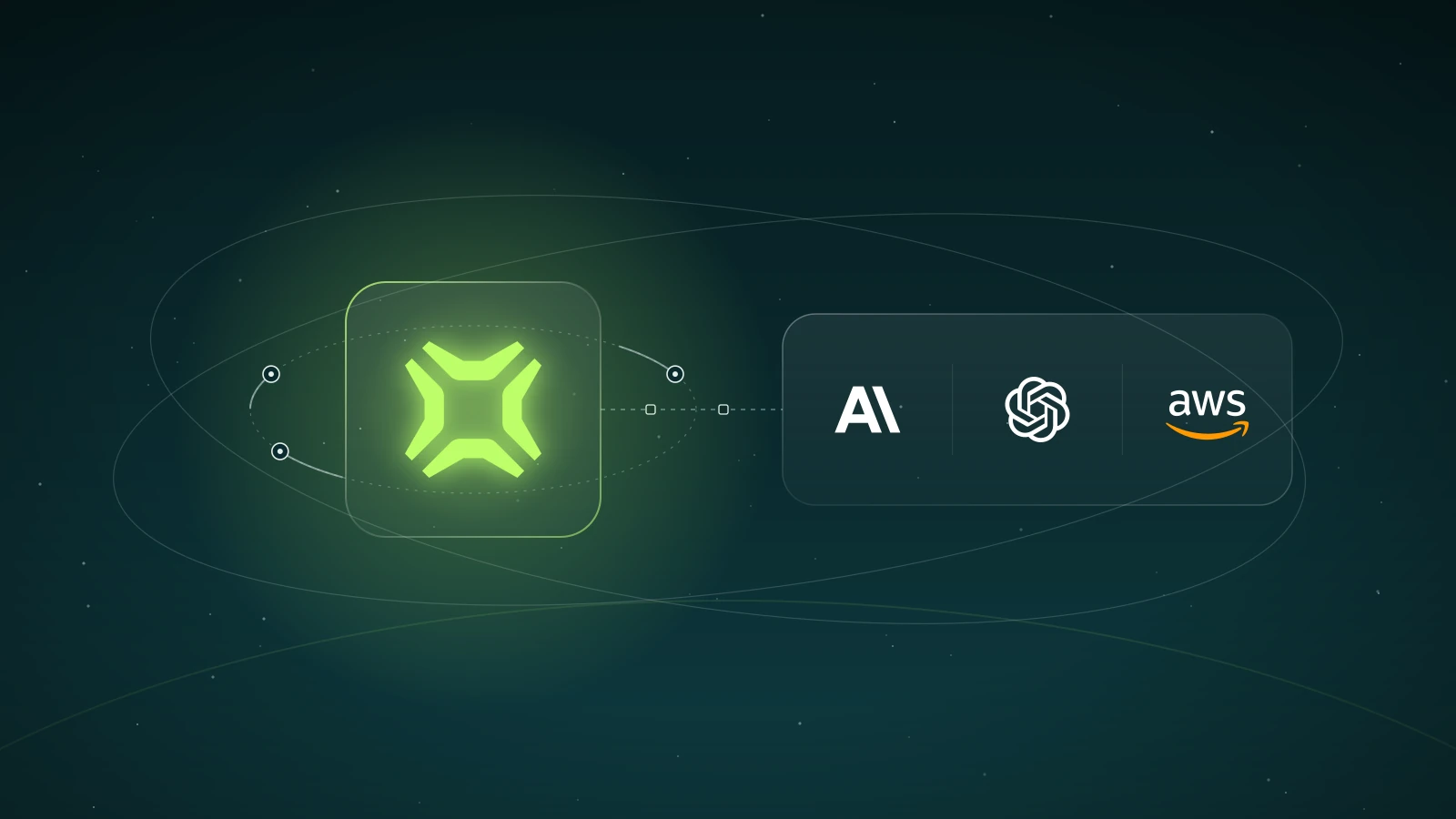
Connect Console to your model (Claude, OpenAI, or a model on Amazon Bedrock) and you're good to go. The built-in tasks come from our Kafka expertise to get you started, and we'll add more in the coming months.
An agent is a task, an identity and limits, running inside Console. A change on your Kafka or a schedule wakes it, it works with your model, and it hands a report, a recommendation or an approval to the team that owns the problem:
Ask Conduktor About the Page You're On
Say a bug in a checkout release writes one truncated JSON order to the orders topic. Consumers like orders-service fail on it and stop making progress, and orders stop going through. The developer gets paged as the lag climbs, opens Console and asks Ask Conduktor what's going on:
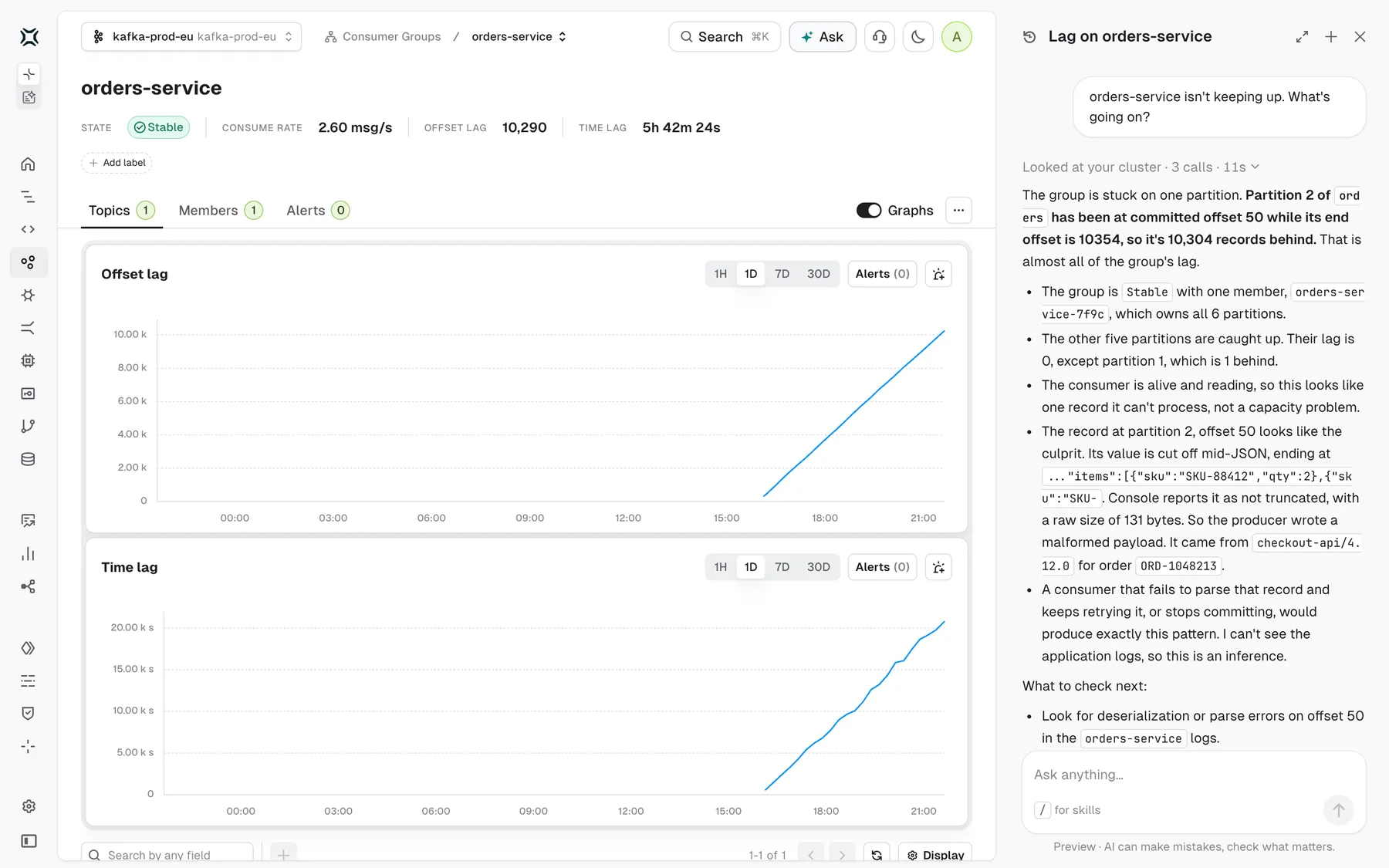
Ask Conduktor traces the problem to one record at offset 50 whose JSON is cut off, and names the release that wrote it: checkout-api/4.12.0.
Turn a Question Into an Agent
To automate the check, you can ask for an agent in the same chat. Here, "Check this every hour and tell me if it gets stuck again" led Ask to navigate Console and fill in the agent form step by step, so you see exactly what it sets up and learn how it works. It stops before creating anything:
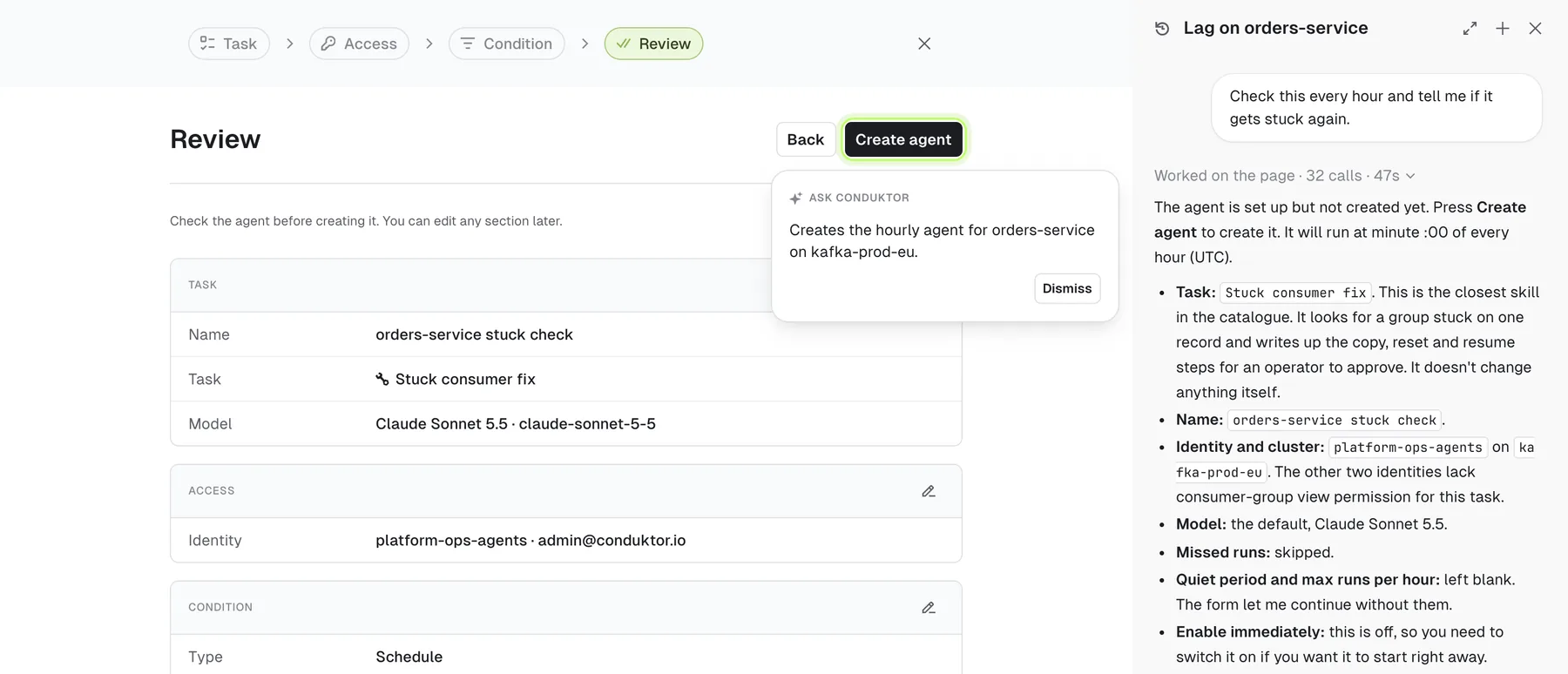
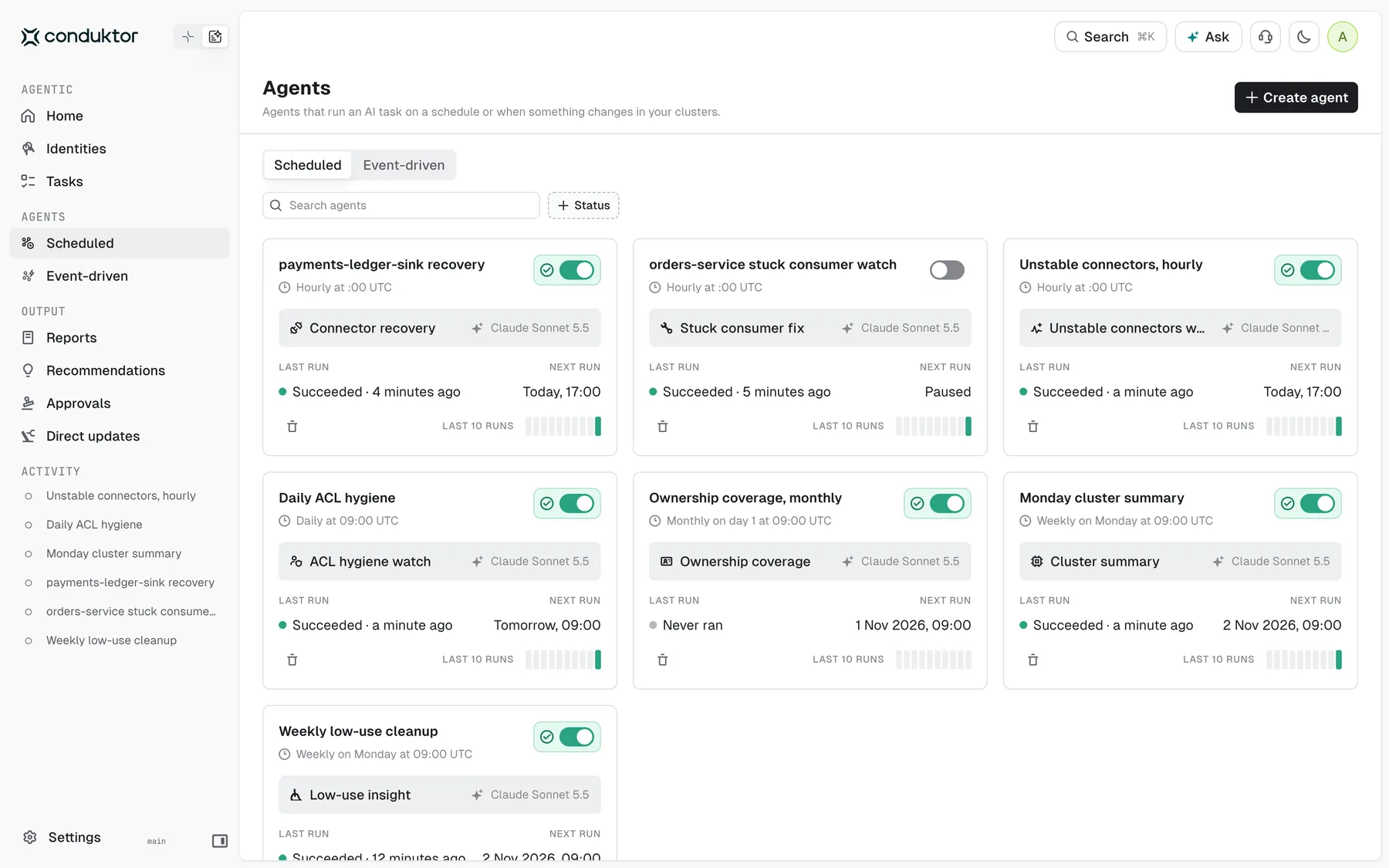
An agent runs on a schedule or on an event: a topic, subject, consumer group or connector created, updated or deleted. We're adding higher-level events too, such as connection storms seen by Conduktor Gateway on the data plane. Out of the box, agents cover every team:
| For | What agents check |
|---|---|
| App teams | A consumer stuck on one record, with the steps to unblock it · A failing connector, restarted or escalated to its owner · A risky schema change, with the check to run first · … |
| Platform team | The health and size of each cluster · Connectors that fail or keep restarting · Topics no application owns, most used first · … |
| Security | Over-broad or unclaimed access, with a tighter grant · Certificates close to expiry · The most valuable topics, and who reads them · … |
| FinOps | What each application costs, and what moved · Empty and stale topics, with an owner to ask · Consumer groups nobody runs anymore · … |
Choose How Far Each Agent Goes
Each task has a fixed level:
| Level | What the agent does | What changes on the cluster |
|---|---|---|
| Report | Reads, ranks and explains what it found | Nothing |
| Recommendation | Says what should change and why. No steps. | Nothing |
| Approval | Asks a person to approve steps | Nothing. A person still runs the steps |
| Automation | Makes the change, in custom tasks you allow to | What the task is allowed to change |
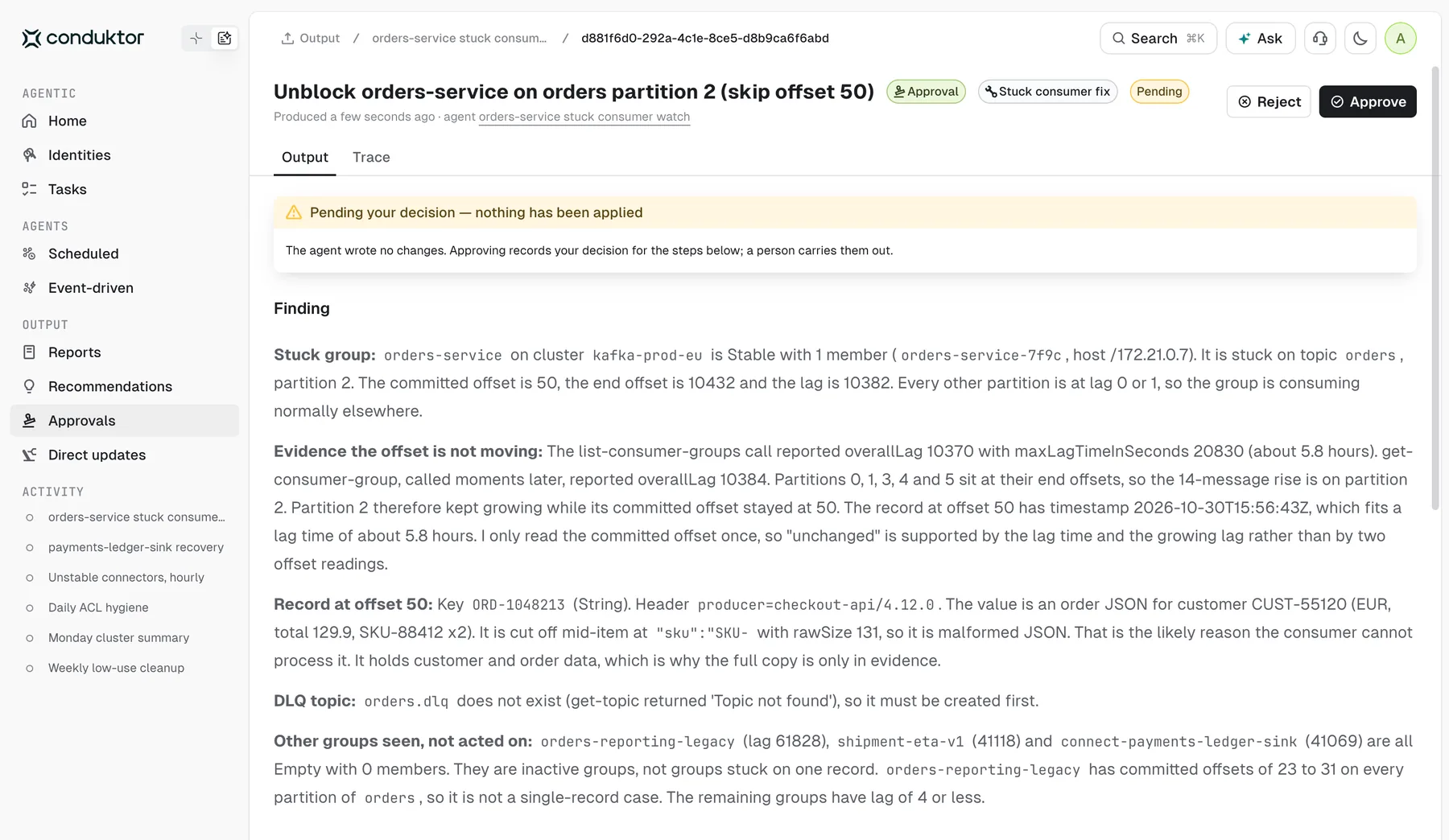
You read its investigation, the evidence and who is affected. The decision stays yours.
Because Conduktor wraps your Kafka with your organization's knowledge (which team owns what, data policies, metadata), each finding names the team that owns the resource, so the big picture comes with it.
Conduktor Agents Are Secure by Construction
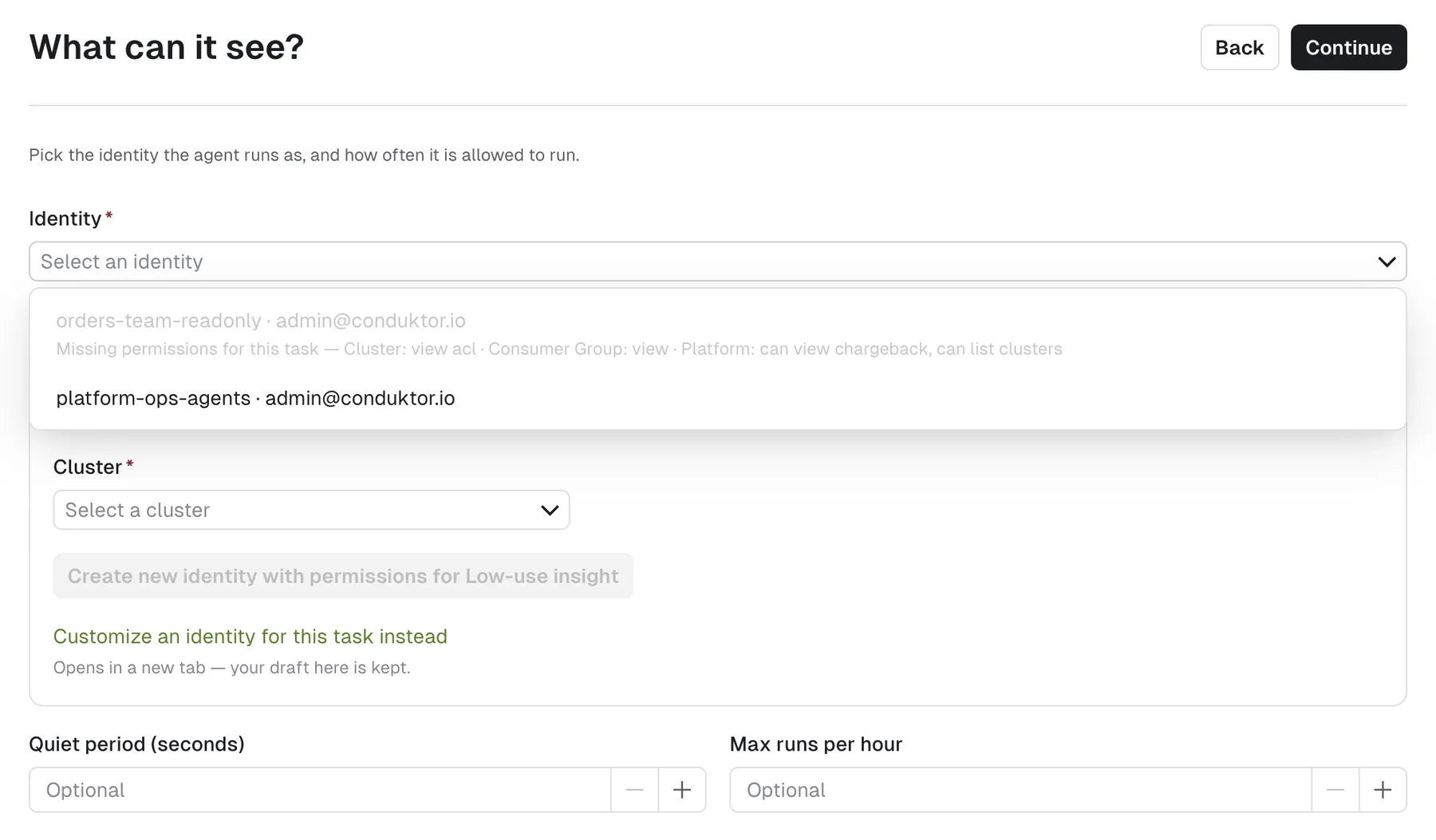
To run agents safely, we introduced a new concept: the agent identity.
It's neither a human identity nor a classic application service account. It sits in between, with a few rules:
- Never above its creator. An agent never gets more permissions than the user who created it, checked on every call.
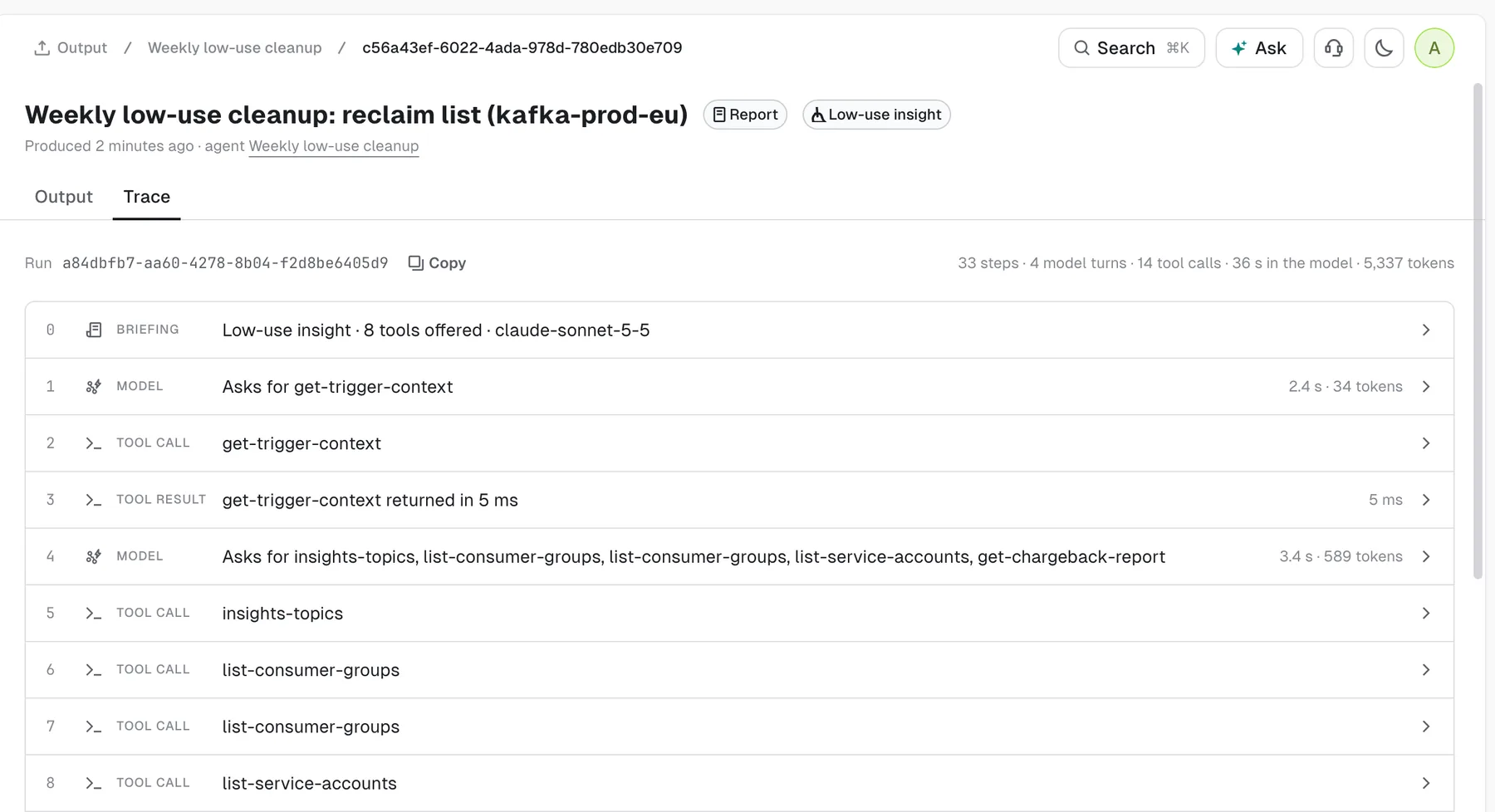
- A short list of tools. Each task calls only its own subset of MCP tools, so no agent can do everything.
- Hard limits on every run. Model calls, tool calls, tokens and duration are capped, and a run stops if the model repeats the same call.
- Everything traced. Every model turn, decision and tool call is recorded.
Try Conduktor Agents
Agents and Ask Conduktor are free in the latest Console, on any cluster Console connects to: self-managed, Amazon MSK, Confluent Cloud, Redpanda or Aiven. We're releasing them to the community to learn how you use them. Connect your LLM, create your first agent, and let it help you troubleshoot and find what to improve. Install Console free →
The Conduktor Agents page shows what the agents check, how approvals work and what the first ones look like in Console.
I would have loved having this back then, for myself and for the teams I was helping. We started by helping people use Kafka. With agents, building on it takes much less Kafka expertise, and more teams can build on streaming without waiting for the few who know it.
To see their superpowers, talk to us →.
Related: Kafka Teams Spend Too Much Time on Routine Work → · Conduktor MCP and Skills for AI Agents →