
Conduktor vs AKHQ: Kafka UI Comparison
AKHQ is the most complete of the free Kafka UIs. Conduktor Console does the same day-to-day operations, free in Community Edition, and keeps going where a UI stops: ownership, self-service guardrails, alerting, cost attribution, and infrastructure as code.
One of the most complete open-source Kafka UIs
AKHQ covers more ground than most people expect from a free tool: multi-cluster, several ways to log in, group-based RBAC, masking, audit logging, ksqlDB, and broad registry support. Under Apache 2.0, actively maintained, with a long track record.
What it isn't is a platform-team control plane. Permissions are groups in a config file, not resources with owners. There's no catalog, no self-service with guardrails, no approval workflow, no alerting, and no cost attribution. When a second and third team arrive, the platform team becomes the approval queue.
Conduktor's Community Edition is free too, for 50 users and 3 clusters, so the comparison is about scope rather than price.
Competitor details last checked against the AKHQ documentation and repository, September 2026.
Where Conduktor and AKHQ diverge
Four capabilities that decide the evaluation for most platform teams.
Ownership and self-service
Catalogs, guardrails, and approval workflows. AKHQ groups grant access; they do not assign ownership.
Monitoring and alerts
Lag, throughput, broker, and connector alerts to Slack, Teams, email, and webhooks. AKHQ has no alerting.
Cost attribution
Spend attributed to topics, applications, and teams. Not in AKHQ's scope.
Infrastructure as code
A Terraform provider for Console resources. AKHQ ships modules to deploy itself, not to manage permissions.
Conduktor Console vs AKHQ: feature comparison
Conduktor Community Edition is free for up to 50 users and 3 clusters. Where a capability needs a paid plan (Team Edition or Enterprise), the note says so.
| Capability | Conduktor Console | AKHQ |
|---|---|---|
| License & cost | ⚠Commercial; free Community Edition (50 users, 3 clusters), paid plans with unlimited clusters. See pricing → | ✓Apache 2.0, free |
| Multi-cluster | ✓Any Kafka provider, unlimited clusters on paid plans | ✓Any Kafka provider |
| Deployment footprint | ⚠Console container plus a PostgreSQL database | ✓Single stateless container, no database |
| Topic & message operations | ✓Browse, filter, produce, replay, and reprocess, including from a DLQ; reset offsets with a preview; automatic Avro, Protobuf, and JSON Schema decoding | ✓Browse, search, produce, and manage topics and consumer groups |
| Schema Registry | ✓Confluent Schema Registry and AWS Glue, with subject ownership through applications | ✓Confluent Schema Registry, AWS Glue, TIBCO |
| Kafka Connect | ✓Manage connectors, restart individual tasks, error traces, auto-restart of failed connectors (paid plans) | ✓View and manage connectors |
| ksqlDB | ✓Integration for teams running ksqlDB | ✓Supported |
| Authentication | ✓OIDC and LDAP in every tier | ✓Basic, LDAP, OIDC, GitHub, AWS MSK IAM |
| RBAC | ✓Permissions scoped to topics, consumer groups, subjects, and connectors, managed in the UI, API, or Terraform; group-level RBAC on paid plans | ⚠Group-based roles defined in configuration; no UI management or approval workflows |
| Data masking | ⚠Field-level masking in Console masks the Console screen (unlimited on paid plans); masking every client needs Conduktor Gateway | ⚠Masks fields on the AKHQ screen only; clients reading Kafka directly see the raw payload |
| Audit log | ✓Who did what, when, across every resource; unlimited retention on paid plans | ✓Audit logging |
| Monitoring & alerts | ✓Cluster, topic, and consumer lag metrics; alerts to Slack, Teams, email, and webhooks; Prometheus integration | ✗Lag and metrics in the UI only; no alerting |
| Infrastructure insights | ✓Health score per cluster, partition skew, stale topics, under-replication risk, data quality rules | ✗Not available |
| Ownership & self-service | ✓Application and topic catalogs, guardrails, approval workflows (paid plans) | ✗Not available |
| Terraform | ✓Official provider for Console resources | ⚠Modules to deploy AKHQ; no provider for permissions or Kafka resources |
| Chargeback | ✓Cost attribution by topic, application, and cluster (paid plans) | ✗Not available |
| Wire-level security | ⚠Encryption, masking, and virtual clusters through Conduktor Gateway, a separate proxy to deploy | ✗Not applicable |
| AI assistance | ✓MCP server inside Console, scoped to each user's RBAC: read-only, or write-enabled for low-risk tasks like labelling topics | ✗Not available |
| Support | ✓Vendor support in every paid tier; SLA in Enterprise | ⚠Community support through GitHub |
IncludedPartial or gated behind a higher tierNot available
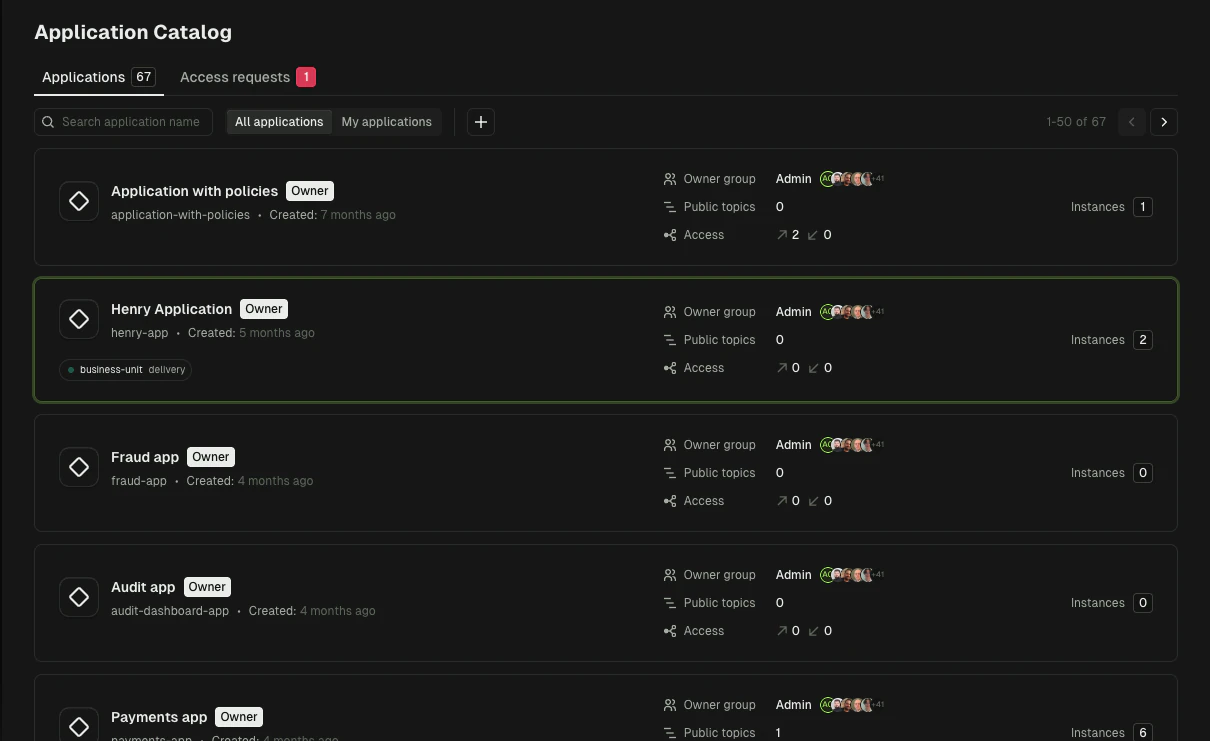
Federated ownership
Groups grant access. Catalogs assign responsibility.
AKHQ's groups answer "may this user read this topic". Console's catalogs also answer "who owns it, who consumes it, and who approves the next request". Developers self-serve inside guardrails the platform team defines once; owners approve cross-team access from the catalog.
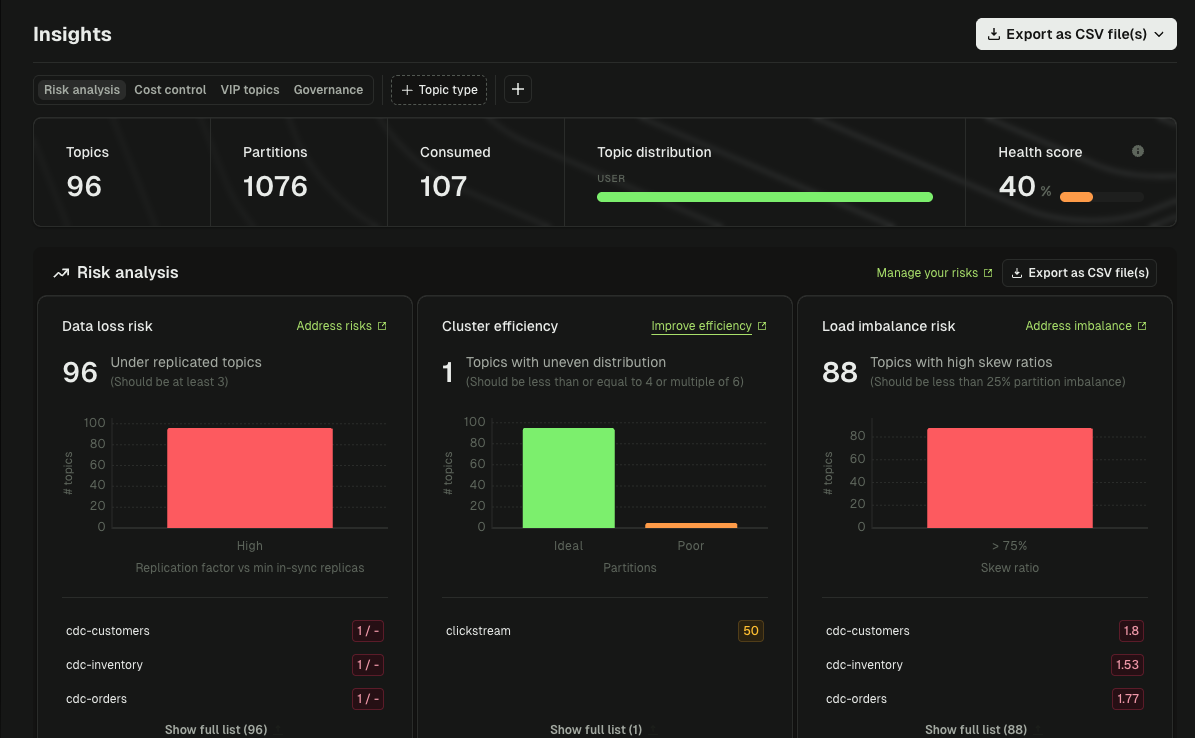
Insights
Health scoring across the whole estate
Console scores each cluster's health and flags partition skew, stale topics, under-replication risk, and VIP topics that need attention, with CEL-based data quality rules on the payloads themselves. AKHQ shows a topic's state when you open it; it doesn't tell you which of your 4,000 topics to open.
AKHQ fits if...
It already covers what your team needs, you want an Apache 2.0 project rather than a vendor, and alerting and governance live elsewhere in your stack. That's a reasonable place to be.
Conduktor fits if...
You want the same operations, free for 50 users and 3 clusters in Community Edition, with a path to ownership, self-service with guardrails, alerting, health insights, cost attribution, and Terraform-managed configuration as more teams share Kafka, plus a support contract.
Read more customer stories


Is AKHQ still maintained?
Yes. AKHQ is actively maintained under Apache 2.0 (0.28.0 shipped in August 2026), with regular releases that have added multi-cluster RBAC, OIDC, AWS MSK IAM, and audit logging over time.
Does AKHQ have audit logs and RBAC?
Both. RBAC is group-based and defined in configuration, mapped to LDAP, OIDC, or GitHub groups; audit logging records user actions. What it lacks is an ownership model, approval workflows, alerting, and a UI or Terraform provider for managing permissions.
Is Conduktor free like AKHQ?
Conduktor Community Edition is free and self-hosted for up to 50 users and 3 clusters, including SSO/LDAP, API, CLI, the Terraform provider, and MCP. Paid plans add federated ownership, chargeback, unlimited audit logs, group-level RBAC, and unlimited clusters; see pricing.
Can I migrate from AKHQ to Conduktor?
Yes, with no data migration. Console connects to the same clusters, Schema Registry, Connect, and ksqlDB. AKHQ groups become Console permissions, usually defined through the Terraform provider so they live in Git from the start.
How does AKHQ compare to Kafbat UI?
They are close. AKHQ has a longer track record, ksqlDB, TIBCO registry support, and audit logging; Kafbat has an MCP server and cloud IAM integrations for AWS, GCP, and Azure. Neither has ownership, self-service, alerting, or chargeback. See Conduktor vs Kafbat UI and the Kafka UI roundup.
Try Console free, on your own clusters
Community Edition: 50 users, 3 clusters, SSO, API, CLI, Terraform, and MCP. Self-hosted, no card.