
Conduktor vs Confluent Control Center: Kafka Governance Compared
Control Center monitors Confluent Platform clusters. Conduktor Console governs every Kafka you run, Confluent included, with ownership, self-service, and cost attribution that Confluent sells as separate, mostly Cloud-only products.
Extending what Confluent provides
Confluent built the most widely adopted Kafka ecosystem, and its next-generation Control Center is a solid monitor for Confluent Platform. It is still only that: a monitor, for Confluent clusters, licensed as part of the enterprise bundle.
What it doesn't answer is who owns each resource, how guardrails get enforced, how developers get access without queuing on the platform team, and which business unit drives the bill. Console answers those in one product, across Confluent and everything else you run.
Since IBM closed the Confluent acquisition in March 2026, platform teams are also asking how much of their tooling should depend on one vendor. Console runs alongside Confluent rather than replacing it, so that question doesn't require a migration.
Competitor details last checked against Confluent documentation, release notes, and public announcements, September 2026.
Where Conduktor and Control Center diverge
Four questions that decide the evaluation for most platform teams.
Every provider, one control plane
Confluent, MSK, Redpanda, Aiven, and Apache Kafka under one set of policies. Control Center: Confluent Platform only.
Ownership and self-service
Catalogs, guardrails, and approval workflows in the product. Control Center has no ownership model.
Cost attribution
Spend attributed to topics, applications, and teams. No equivalent in Control Center.
Security for any Kafka
Gateway enforces encryption and masking in front of any Kafka. Confluent's gateway covers Confluent Private Cloud.
Conduktor Console vs Confluent Control Center: feature comparison
Conduktor Community Edition is free for up to 50 users and 3 clusters. Where a capability needs a paid plan (Team Edition or Enterprise), the note says so.
| Capability | Conduktor Console | Confluent Control Center |
|---|---|---|
| Kafka providers | ✓Any Kafka: Confluent Platform and Cloud, Amazon MSK, Redpanda, Aiven, Apache Kafka | ✗Confluent Platform clusters only; Confluent Cloud uses a separate web UI |
| Schema Registry | ✓Confluent Schema Registry and AWS Glue, with subject ownership tracked through applications | ⚠Confluent Schema Registry only |
| Operational metrics | ⚠Broker throughput, replication status, disk usage, topic and consumer metrics; pair with Prometheus for broker-internal telemetry | ✓Deeper Confluent Platform telemetry: throughput, replication, end-to-end latency; Prometheus-based in the next-generation release, up to 400K partitions |
| Confluent-native components | ✗Cluster Linking, Replicator, and Confluent broker configuration stay in Confluent tooling | ✓Built for them |
| Infrastructure insights | ✓Health score per cluster, partition skew, stale topic detection, under-replication risk, VIP topic detection | ✗No equivalent |
| Alerting | ✓Alerts on topics, brokers, consumer lag, and connector failures to Slack, Teams, email, and webhooks | ⚠Alerting through the Prometheus Alertmanager stack in next-generation Control Center |
| Authentication | ✓OIDC and LDAP in every tier, including Community | ✓LDAP and SSO through Confluent's Metadata Service, part of the enterprise license |
| RBAC | ✓Permissions scoped to specific topics, consumer groups, subjects, and connectors, managed in the UI, API, or Terraform; group-level RBAC on paid plans | ✓Confluent Platform RBAC with role assignments managed in the Control Center UI or CLI; enterprise license, Confluent clusters only |
| Developer UX | ✓Browse, filter, produce, replay, and reprocess messages, including from a DLQ; reset offsets with a preview; restart individual connector tasks | ⚠Topic browsing and basic produce; connector management; no message replay or DLQ reprocessing |
| Terraform | ✓Official provider for topics, schemas, connectors, policies, groups, and permissions across any provider | ⚠Confluent's provider manages Confluent resources only |
| Ownership & self-service | ✓Application and topic catalogs, self-service provisioning with automated guardrails, approval workflows (paid plans) | ✗Not in Control Center; Stream Catalog and Stream Governance are separate products centered on Confluent Cloud |
| Chargeback | ✓Cost attribution by topic, application, and cluster (paid plans) | ✗No native capability |
| Data security on the wire | ⚠Conduktor Gateway: field-level encryption, masking, virtual clusters, in front of any Kafka; a separate proxy to deploy | ⚠Confluent Private Cloud Gateway: schema enforcement, field-level and full-payload encryption, for Confluent Private Cloud clusters; CSFLE for Confluent Cloud |
| Free tier | ✓Community Edition: 50 users, 3 clusters, SSO/LDAP, API, CLI, Terraform, and MCP | ⚠Free developer license covers a single broker only; multi-broker clusters need a Confluent Platform enterprise license after a 30-day trial |
| Pricing model | ✓Free Community Edition; Team Edition (buy online) and Enterprise (via sales) both include unlimited clusters. See pricing → | ⚠Bundled into the Confluent Platform enterprise license; not published |
| AI assistance | ✓MCP server inside Console, scoped to each user's RBAC: read-only, or write-enabled for low-risk tasks like labelling topics | ⚠Confluent ships a separate MCP server, built around Confluent Cloud and its APIs rather than Control Center |
IncludedPartial or gated behind a higher tierNot available
Multi-vendor governance
One set of policies for Confluent, MSK, and everything else
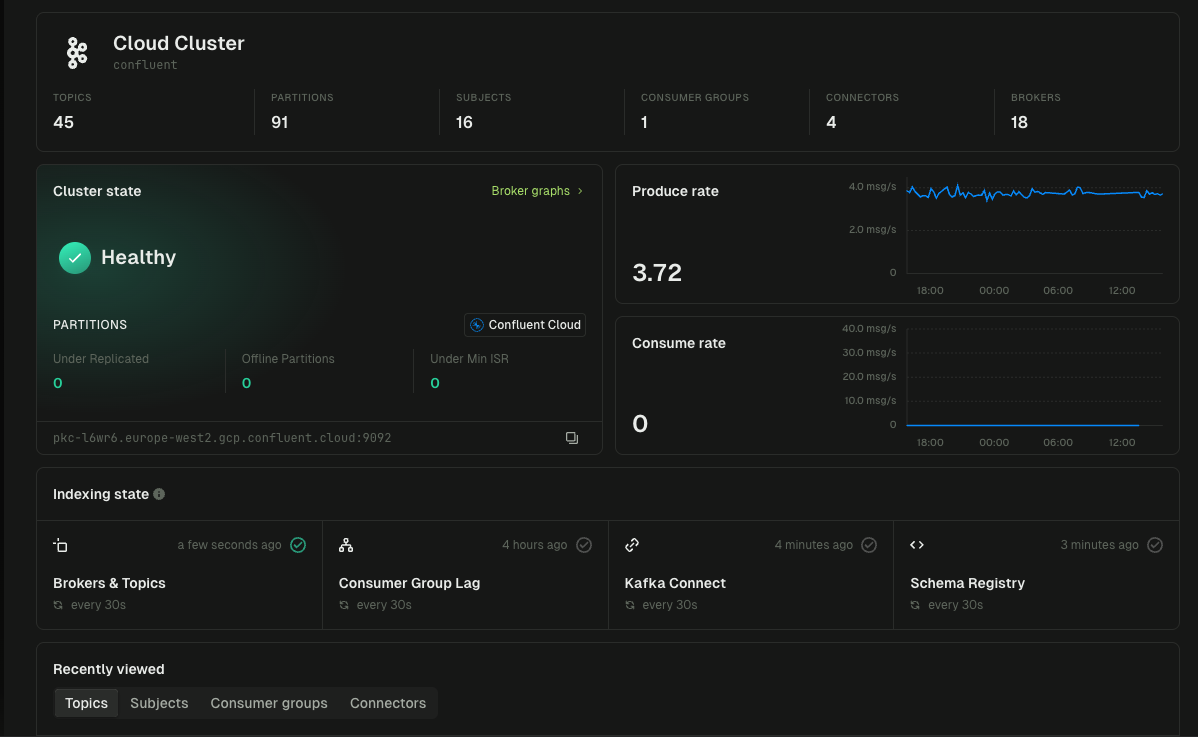
Acquisitions, regional requirements, and cost reviews leave most enterprises with more than one Kafka provider. Console applies the same RBAC, topic policies, catalogs, and alerts across all of them, so adding a second provider doesn't mean starting governance over. Control Center covers the Confluent Platform clusters and nothing else.
Federated ownership
Self-service that does not bottleneck the platform team
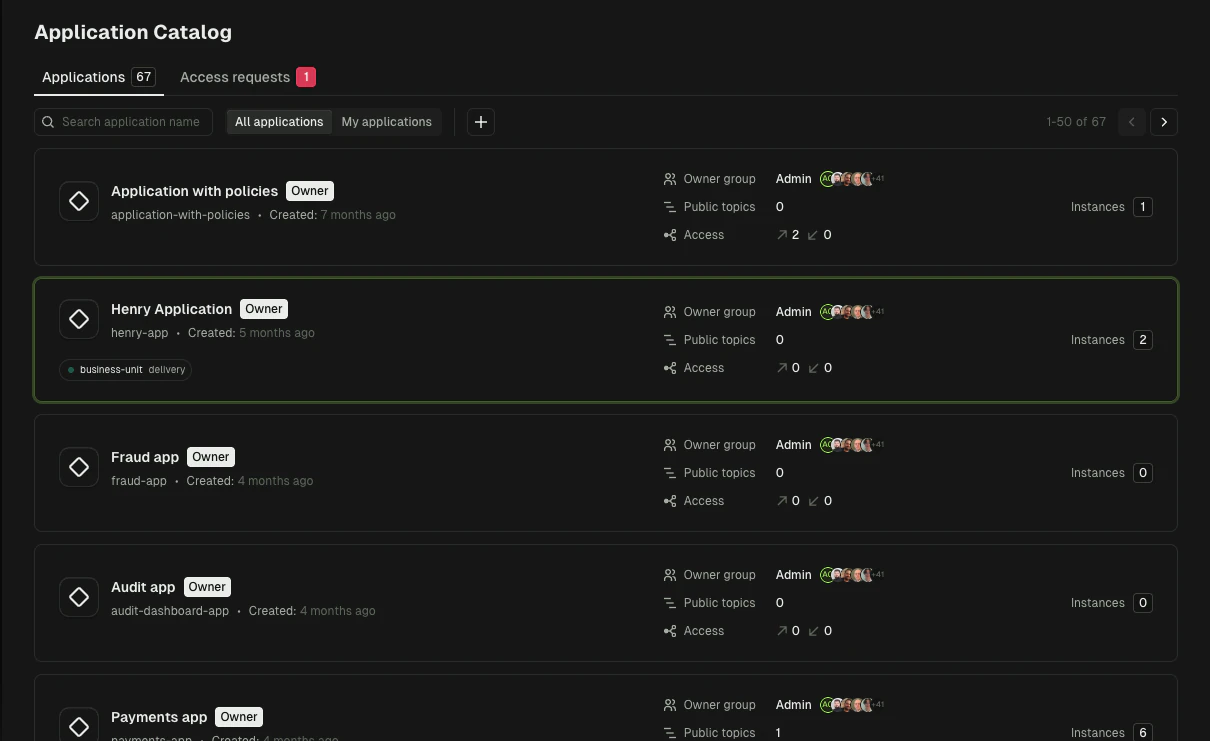
Developers create topics, schemas, and connectors inside guardrails the platform team defines: naming, partitions, retention, replication. Owners approve access requests from the catalog. Control Center has no ownership model, so provisioning still runs through tickets or the Confluent CLI.
Cost attribution
Turn one Confluent invoice into per-team accountability
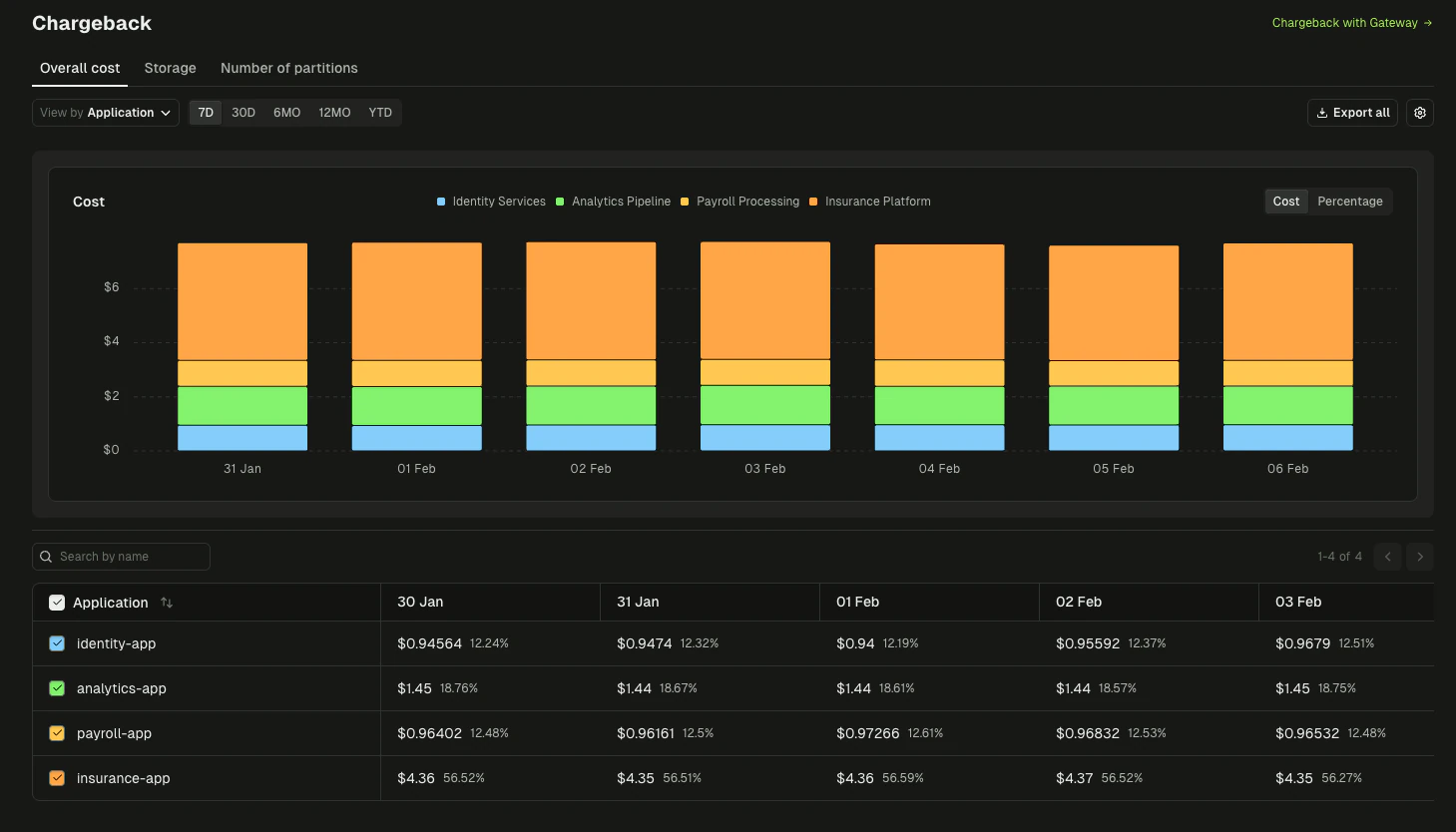
Console attributes cluster spend to topics, applications, and the teams that own them, so a platform team can hand finance a chargeback breakdown instead of a single line item. Control Center reports metrics; it doesn't attribute cost.
Control Center fits if...
Your entire estate is Confluent Platform, you already hold the enterprise license, and you need cluster health monitoring rather than multi-team governance. Next-generation Control Center is a solid monitor for that footprint.
Conduktor fits if...
You run Confluent alongside other Kafka providers, or expect to; several teams share clusters and need catalogs, guardrails, and approval workflows; you need to attribute cost by team; or you want encryption and masking enforced on the wire for every provider, not only Confluent Private Cloud.
"Confluent Cloud without governance on top is unusable for our enterprise. I will never let a user touch the portal directly. Everyone goes through Conduktor."
IT Project Lead
Leading German Automotive Manufacturer
"Conduktor is our main visualization tool. We don't even rely on Control Center 99% of the time."
Platform team
Multi-Strategy Investment Fund
Read more customer stories



Does Conduktor replace Confluent?
No. Console manages Confluent Platform and Confluent Cloud clusters as standard Kafka, alongside MSK, Redpanda, Aiven, or Apache Kafka. Teams keep their Confluent brokers, Schema Registry, and Connect and add Console as the governance and operations layer across all of them.
Can we use Conduktor with Confluent Cloud?
Yes. Console connects to Confluent Cloud with standard credentials and Confluent Schema Registry, and Conduktor Gateway can sit in front of Confluent Cloud to add encryption, masking, and virtual clusters. Some customers make Conduktor the only surface their developers touch, with the Confluent portal reserved for the platform team.
Is next-generation Control Center a big improvement?
Yes, operationally. Startup time fell from 15 to 50 minutes to about one, partition scale rose to 400,000, and the separate metrics cluster is gone in favor of Prometheus. Moving from legacy Control Center is a full migration that discards historical metrics. What didn't change is scope: it still monitors Confluent Platform only and has no ownership, self-service, or chargeback model.
How does Confluent Private Cloud Gateway compare to Conduktor Gateway?
Both are protocol-aware proxies. Confluent's enforces schema validation and field-level or full-payload encryption for Confluent Private Cloud clusters. Conduktor Gateway works in front of any Kafka and adds virtual clusters, traffic control, data quality rules, and partner data sharing. The full comparison is on the Kafka proxy roundup.
What does the IBM acquisition change for Confluent customers?
IBM completed the acquisition in March 2026. Product roadmaps and pricing are IBM's to announce; the practical effect for many platform teams has been a review of how much tooling depends on a single vendor. Console is provider-neutral by design, so it can be adopted without changing where your brokers run.
How hard is it to add Conduktor next to Control Center?
Console connects to existing clusters and Schema Registry with no data migration. RBAC and topic policies are defined in Console, usually through the Terraform provider so they live in Git. Teams typically run both during the evaluation and keep Control Center for broker-level metrics if they want it.
See Console next to your Confluent clusters
Thirty minutes, your Kafka: multi-vendor governance, ownership catalogs, cost attribution, and encryption on the wire.