
Conduktor Gateway vs Kong Event Gateway: Kafka Proxy Compared
Kong Event Gateway brings Kafka into the API platform your API team already runs. Conduktor Gateway is a Kafka proxy first, self-managed end to end. The evaluation turns on who is running it and where the control plane is allowed to live.
An API gateway that learned Kafka
Kong Event Gateway speaks native Kafka and gives an API team a coherent story: virtual clusters, encryption, schema validation, and a portal, in the same platform and policy language as their REST APIs. For that team, it's a natural extension.
The constraint is the control plane. The data plane runs in your environment, but every policy and configuration change routes through Kong Konnect, Kong's SaaS, with no on-premises option. For air-gapped or data-residency-bound Kafka estates, that decides the evaluation before features do.
On features, the depth ends where an API gateway's model ends: no cluster failover, no chaos testing, and no governance of the Schema Registry itself.
Competitor details last checked against Kong's Event Gateway documentation and release posts, September 2026.
Where Conduktor Gateway and Kong Event Gateway diverge
Four questions that decide the evaluation.
Where the control plane lives
Conduktor Gateway is self-managed end to end, including air-gapped. Kong's data plane is yours; its control plane is Konnect, Kong's SaaS.
Failover you can rehearse
Cluster switching by API call plus chaos-testing interceptors. Kong Event Gateway has no failover or DR capability.
Isolation depth
Virtual clusters layered with ACLs, quotas, and per-tenant policies, plus topic concentration. Kong's virtual clusters isolate by ACL.
Kafka-native governance
Data quality rules on field values, Schema Registry authorization, producer and consumer safeguards. Kong's Kafka policies stop at validation, encryption, and filtering.
Conduktor Gateway vs Kong Event Gateway: feature comparison
Conduktor Gateway is licensed per cluster on the Enterprise plan; the free Community Edition covers cross-network reachability only.
| Capability | Conduktor Gateway | Kong Event Gateway |
|---|---|---|
| License & cost | ⚠Commercial, per cluster with a 3-cluster minimum; free Community Edition for network reachability only. See pricing → | ⚠Licensed through Kong Konnect; Event Gateway pricing not published separately |
| Deployment model | ✓Fully self-managed: data plane and control plane in your environment, air-gapped supported | ⚠Self-managed data plane; control plane is Kong Konnect (SaaS) only, no on-premises option |
| Kafka providers | ✓Any Kafka 2.7+: Confluent, MSK, Redpanda, Aiven, Apache Kafka | ✓Standard Kafka clusters, including MSK and Confluent Cloud |
| Multi-tenancy | ✓Virtual clusters with isolated namespaces, ACLs, quotas, and policies stacked per tenant; topic concentration | ⚠Virtual clusters with ACL-based access and topic virtualization; no layered quotas or concentration |
| Cluster switching & failover | ✓One API call, no client changes; chaos-testing interceptors to rehearse | ✗Not available |
| Replication | ✗Routes, doesn't replicate; pair with MirrorMaker 2, Replicator, or Cluster Linking | ✗Not applicable |
| Encryption | ✓Field-level and full-payload encryption with KMS integration (Vault, AWS, Azure, GCP), plus masking and tokenization | ⚠Message encryption with static keys and field-level encryption for JSON and Avro; no masking or tokenization |
| Data quality | ✓Schema enforcement plus CEL business rules on the wire; violations blocked or logged per policy | ⚠Schema validation on produce and consume; no business rules on field values |
| Schema Registry governance | ✓Schema Registry Proxy: OIDC authentication, per-subject authorization, audit | ✗Registry used for validation only |
| Best-practice guardrails | ✓Topic policies, producer and consumer safeguards, rate limits, large-message handling, per virtual cluster | ⚠ACLs, authentication mediation, message filtering, header modification |
| Authentication | ✓mTLS, SASL, OIDC/OAuth; centralized service accounts and audit | ✓OAuth, mTLS, and SASL mediation to Kafka credentials |
| Protocol mediation | ✗Kafka clients only | ✓Expose topics as REST or SSE APIs through Kong Gateway |
| Developer portal | ⚠Topic and application catalogs in Conduktor Console | ✓Unified API and event portal in Konnect |
| Partner data sharing | ✓Partner Zones: isolated virtual clusters with per-partner masking, credentials, and rate limits | ⚠External access through mediation and ACLs; no per-partner masking or isolation |
| Configuration & change | ✓REST API, CLI, Terraform provider; runtime changes | ✓Konnect UI, API, and Terraform; runtime changes via Konnect |
| Observability | ✓Prometheus metrics, audit log, Console UI | ✓Konnect analytics, OpenTelemetry |
IncludedPartial or gated behind a higher tierNot available
Deployment model
Your data plane and your control plane, in your environment
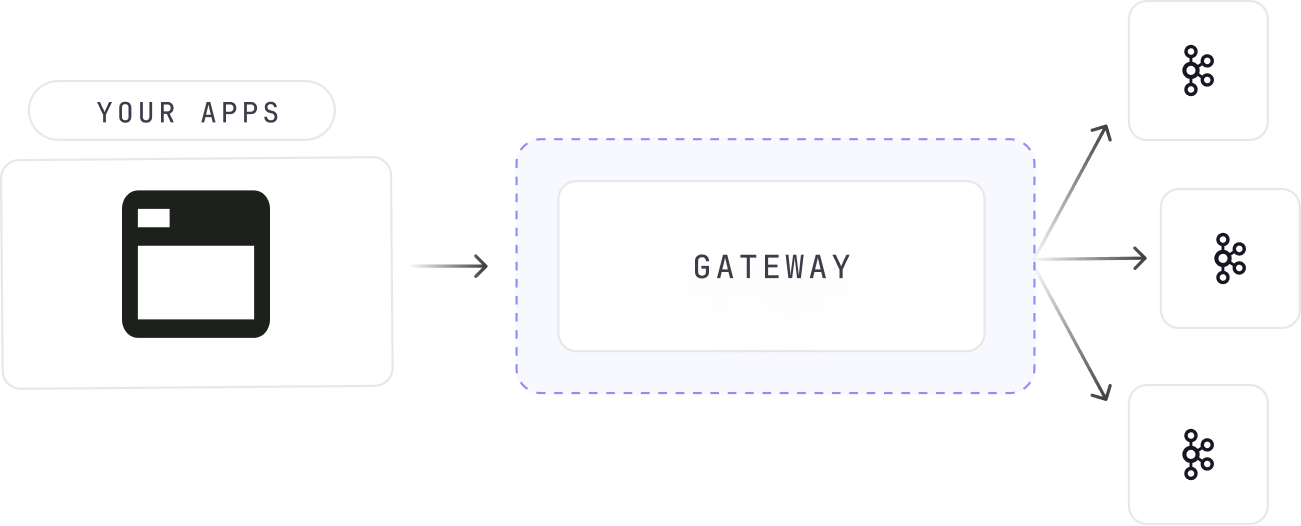
Gateway's configuration, policies, and audit live where your Kafka does, including air-gapped and sovereign deployments. Kong Event Gateway's data plane is self-managed, but every change flows through Konnect in Kong's cloud, which is a hard stop for many regulated Kafka estates.
Failover
Switch clusters with one call, and prove it works first
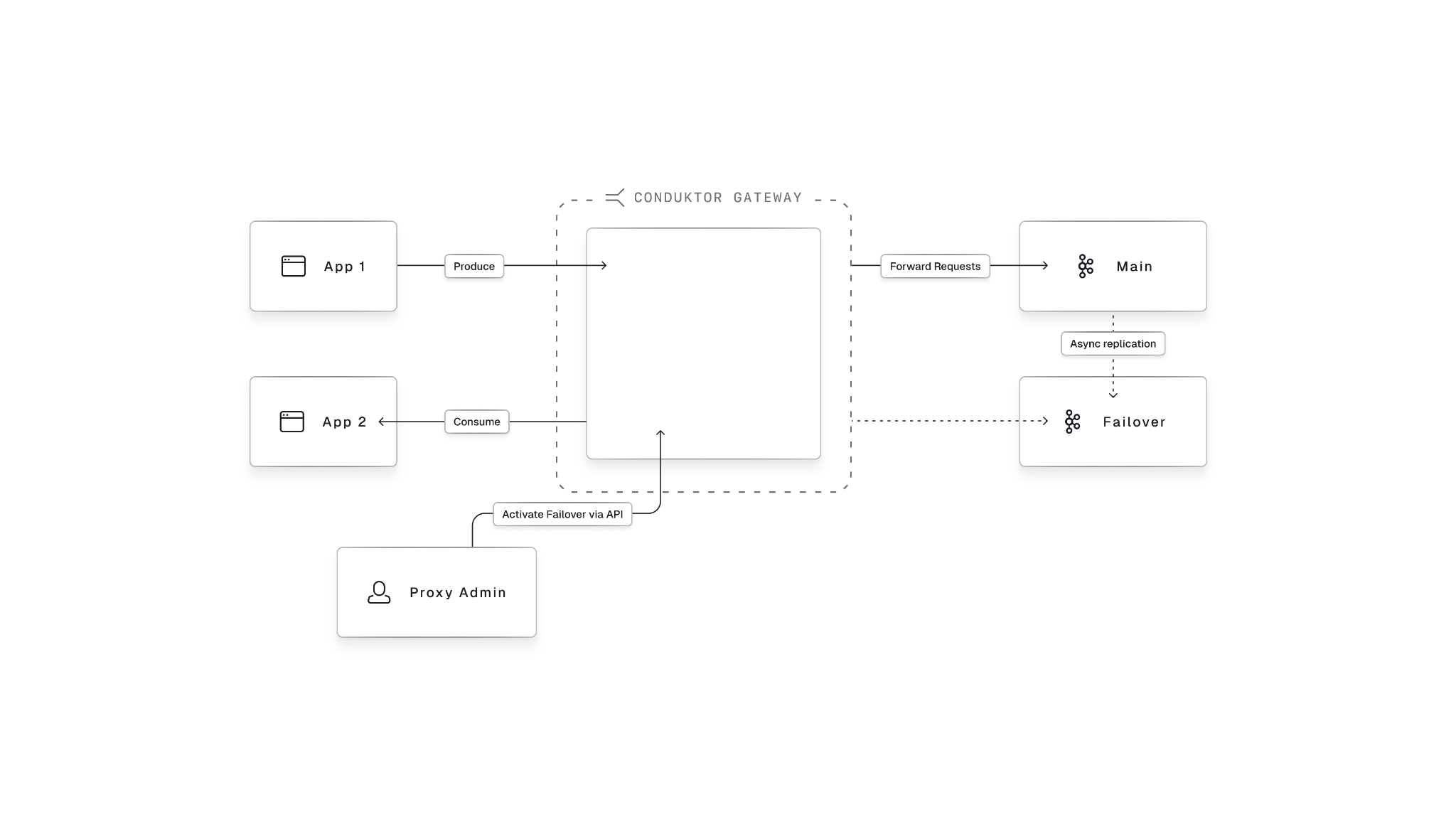
Gateway switches client traffic to a failover cluster through its API with no client changes, and chaos-testing interceptors let you break brokers deliberately to see which applications survive. Gateway doesn't replicate data, so MirrorMaker 2, Replicator, or Cluster Linking still does that. Kong Event Gateway has no failover capability.
Data quality
Rules on the wire, not just schemas
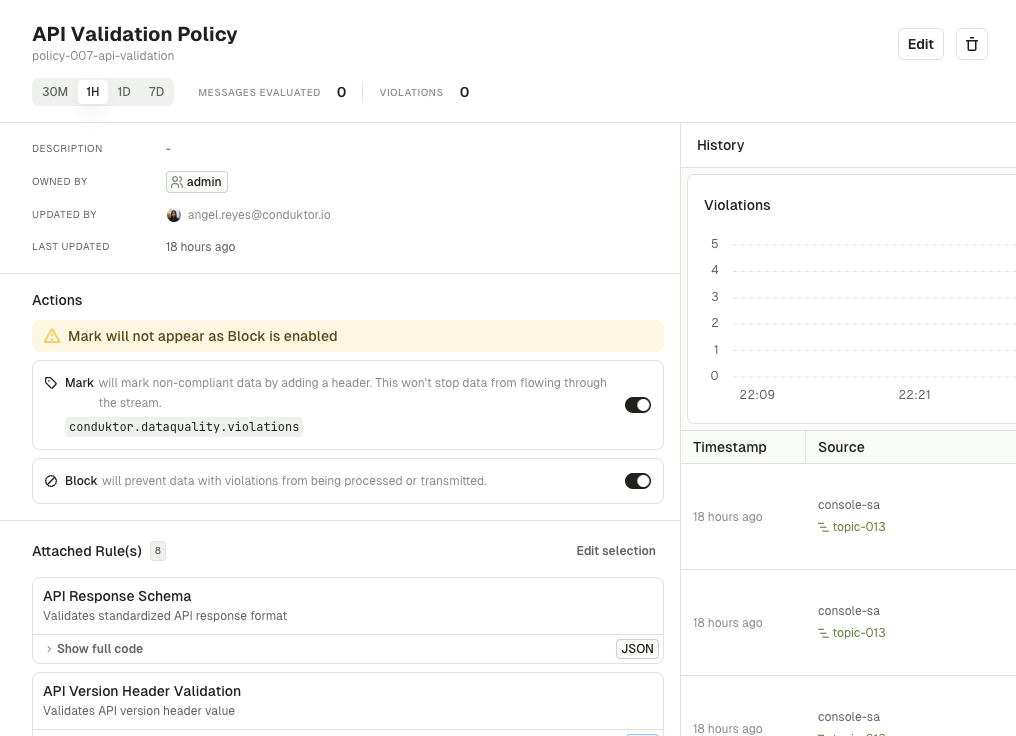
Schema enforcement is the floor. Gateway adds CEL business rules on field values, a block-or-log action per policy, and producer safeguards such as acks, compression, and idempotence requirements, all per virtual cluster. Kong validates against a schema on produce and consume.
Kong Event Gateway fits if...
Your API team already runs Kong Konnect, you want Kafka topics in the same portal and policy model as your REST APIs, exposing topics as HTTP or SSE matters, and a SaaS control plane is acceptable for your Kafka estate.
Conduktor Gateway fits if...
The Kafka platform team owns the decision; you need failover, layered multi-tenancy, data quality rules, or Schema Registry governance; or your Kafka can't depend on a control plane outside your environment.
"The Gateway proxy won me over immediately."
Julien Maillard
Senior Architect, CDC Informatique
Read more customer stories

Does Kong Event Gateway require Kong Konnect?
Yes. The data plane runs in your environment, but the control plane is Konnect, Kong's SaaS. There is no on-premises control plane, so configuration, policies, and monitoring route through Kong's cloud.
Can Conduktor Gateway expose Kafka topics as REST APIs?
No. Gateway is a Kafka-protocol proxy for Kafka clients. If exposing topics as HTTP or SSE to non-Kafka consumers is a primary requirement, Kong (or Gravitee) does that and Conduktor doesn't.
Which one has failover?
Conduktor Gateway. Cluster switching is one API call with no client changes, and chaos-testing interceptors let you rehearse it. Kong Event Gateway has no cluster failover capability. Neither product replicates data; that's MirrorMaker 2, Replicator, or Cluster Linking.
Is Kong's encryption equivalent to Conduktor's?
Kong offers message encryption with static keys and, since 1.2, field-level encryption for JSON and Avro tied to its schema validation policy. Conduktor Gateway adds KMS-managed keys (Vault, AWS KMS, Azure Key Vault, GCP KMS), masking, and tokenization, and covers Protobuf.
Can the API team and the Kafka team both be happy?
Often, yes: Kong at the HTTP edge for REST and event-to-API exposure, Conduktor Gateway in the Kafka data path for isolation, security, and failover. They govern different traffic and don't conflict.
Is there a free Conduktor Gateway?
Gateway Community Edition is free with no time limit, scoped to cross-network reachability. Interceptors, virtual clusters, encryption, and failover are on the Enterprise plan, priced per cluster.
See Gateway in front of your clusters
Thirty minutes: virtual clusters, encryption on the wire, and a failover you can rehearse, with no SaaS control plane.