
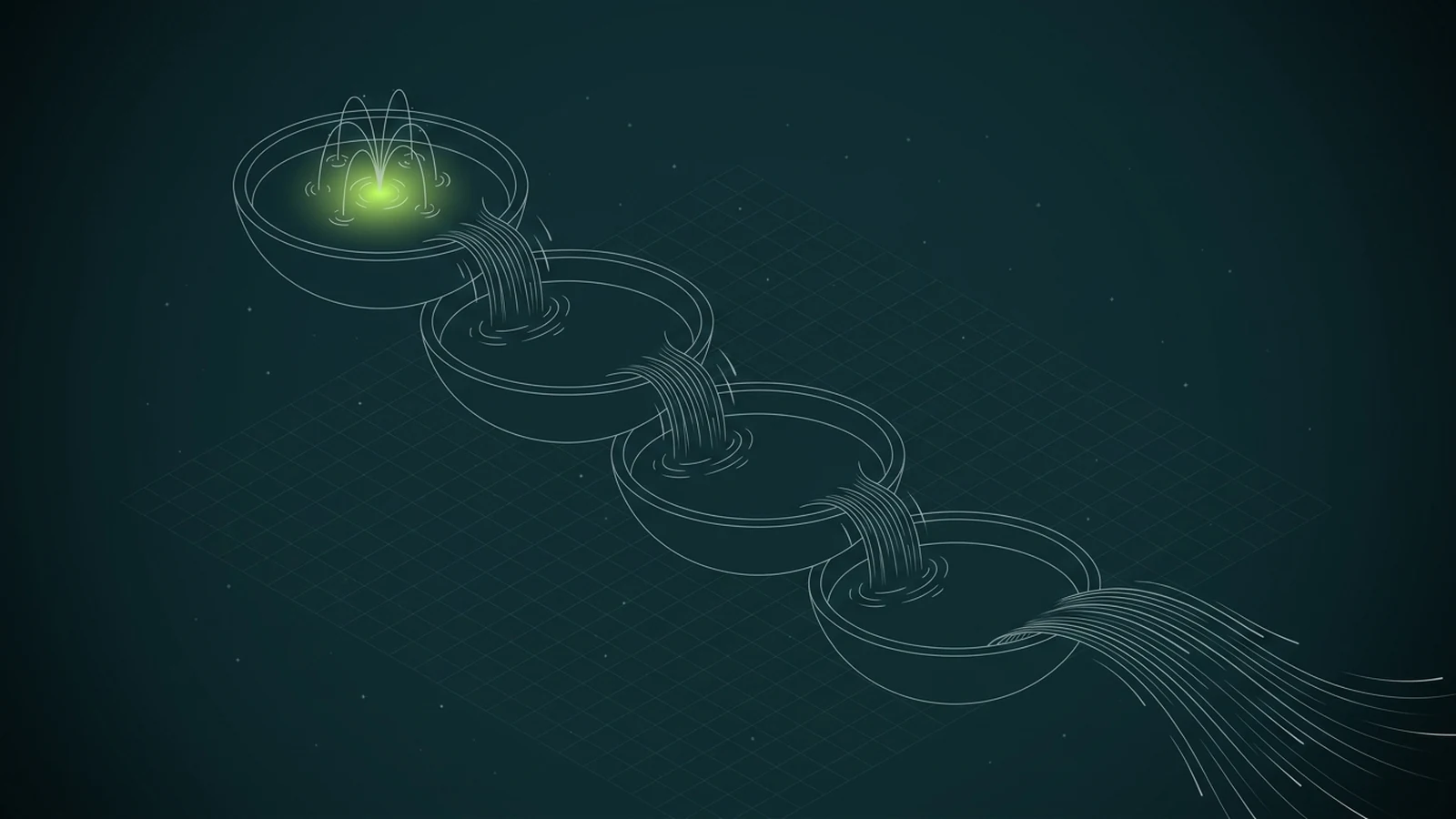
How do you move data around? Faster brokers, cheaper storage, smarter pipelines with more logic inside.
Our VP Engineering, Matt, has a different story: people.
"A business is a group of people trying to achieve something. The technology is for the people, and they need to speak to each other to achieve their goals. You need to know who owns the data, who owns the infrastructure. Who do I speak to if I want to use it, if I have a problem with something?" — Matt Searle
It's about enabling teams to discover who they need to collaborate with. For him, this is the single best thing technology can do.
There is more to it. I want to push it one step further. I don't think ownership is the best thing technology can do. I think it's the first thing. Everything else you want from a Kafka platform sits on top of it: every dataset, every AI use case, every cost saving.
Let me explain.
The first domino
Why do we need ownership? Let's try the contrarian angle: what happens if you don't have it?
No ownership, no accountability.
No accountability, no trust.
No trust, no autonomy.
No autonomy, no self-service.
No self-service, no scale.
No scale, no adoption.
No adoption, no Kafka data platform.
Read it backwards: a platform nobody adopts, because it never scaled, because nothing was self-service, because no team was trusted with autonomy, because nobody was accountable, because nothing was really owned.
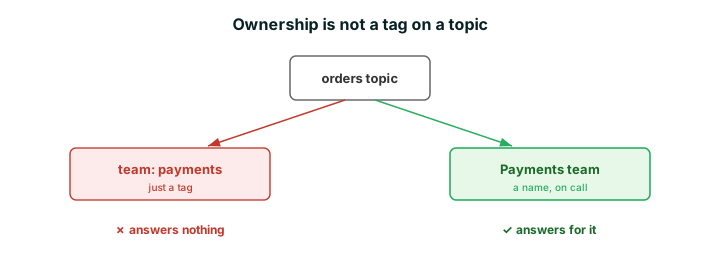
Ownership is not a tag on a topic
🚫 "Ownership? That's just a label on the topic."
This is the version of ownership I see most often, the one a lot of tools ship. Do you think a team: payments tag is ownership? It tells you nothing and does nothing the moment something breaks. Tags like this are footnotes: nice for analytics, useless for accountability.
Ownership is accountability with a person's name attached. Someone owns this topic, this schema, this contract, and "owns" means they answer for it. When the data is wrong, when the cost spikes, when a consumer downstream fails, there's a person and a team who carry it.
Infrastructure ownership and data ownership are not the same thing.
You can know exactly which cluster a topic lives on and still have no idea who owns the schema, who depends on the data, or who to call when there is an issue.
- Knowing the cluster is plumbing.
- Knowing the owner is accountability.
You can't delegate what you can't trust
Accountability produces trust, and trust is what you need before any of the good stuff becomes possible.
Think about what self-service really asks of a platform team. It asks them to let other people:
- create topics
- set retention
- request access
- wire up connectors
- share data with other teams
- be in control of the sensitivity of their data
- etc.
...without a human in the loop on every request. You do not hand that to teams you don't trust. And you can't trust teams who aren't accountable for what they create. Turn on self-service without a strong ownership model, and the platform becomes a free-for-all.
On the other hand, I've seen platform teams build bunkers so locked down nobody bothers using them, either because there are too many controls or because they're just too technical to approach. There's often a lack of empathy towards users who aren't as tech-savvy as the platform team.
You manufacture trust with guardrails that make autonomy safe to grant. A practitioner at Current put it better than I could:
"The key thing for us is approval gates. Guardrails. If somebody goes onto the tool and adds in something ridiculous, like a thousand partitions, we need someone to have eyes on that. That's something we've learned we can't let go of." — Lead streaming data engineer at a bank
Guardrails turn "I trust you" from a leap of faith into a policy, written down and enforced. Then, and only then, autonomy is safe to give, and self-service stops being a liability.
Guardrails are how you hand a team autonomy without hoping for the best.
Self-service is the only thing that scales
Without self-service, your platform team is the ceiling. Topics, permissions, onboarding: it all funnels through them, and they become the bottleneck for the whole organization's use of Kafka.
A CTO peer at a German consultancy told me:
"Internal IT is the bottleneck. They don't manage to build all the requirements coming from business units." — CTO at a German tech consultancy
Often, the platform team is too buried in tickets to build the thing that would end the tickets. Even if you know exactly what to build, you need time to build it and to manage the change.
Manual coordination doesn't scale. People don't scale. Self-service scales, but only on top of the trust and accountability underneath it.
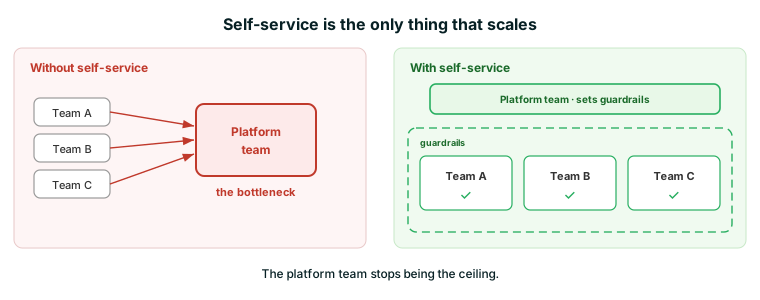
Scale is what drives adoption: teams adopt the platform that gets them moving today, not the one where they have to wait. No scale, no adoption. A platform nobody adopts isn't a platform. It's infrastructure with a UI.
Without self-service, the platform team is the ceiling. With it, the ceiling is gone.
AI made ownership urgent
Before 2025, data governance was hygiene for most (never top priority). With AI, it became urgent.
Almost every AI use case anyone demoed only works in the enterprise if this chain exists.
Agentic demos show the easy part: spinning up infra, writing prompts, executing. The hard part is the data: Is it legible? Who owns it? Can you trust it enough to point an agent at it?
A streaming platform nobody can govern and that cannot scale will not become a streaming platform agents can operate on. The teams that will run AI agents on Kafka in 2027 are the ones getting their ownership right in 2026.
How the chain actually holds
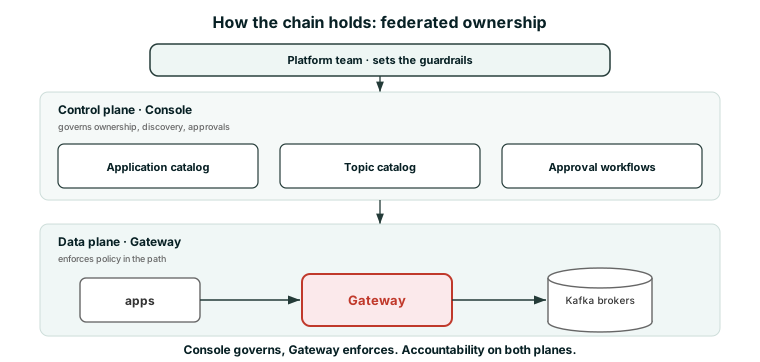
It only works as a system, not in isolation. That's what we've been building toward with federated ownership in Conduktor: the platform team sets the standards and the guardrails, project teams operate inside them with autonomy, and both sides keep authority and visibility. Concretely:
- An application catalog that maps every resource to an accountable team: business and technical ownership, so "who owns this?" always has an answer. "Who do I speak to?" turned into a system of record. Watch the 1-min demo →
- A topic catalog so teams discover and reuse data, understand where it comes from and how sensitive it is, and see who to talk to if they have questions. Watch the 1-min demo →
- Approval workflows where the data owner approves cross-team access, so the platform team is no longer in the middle of it. Watch the 1-min demo →
- Guardrails such as naming, partition and retention limits, and config rules, enforced no matter how you provision: Console, CLI, GitOps, Terraform, or MCP.
- Console holds the ownership, the discovery, and the workflows.
- Gateway enforces the policy in the data path, at the protocol level, without touching your brokers or rewriting your apps.
Together that's accountability on the control and data planes.
Back to Matt
Knowing who to collaborate with isn't the single best thing technology can do. It's the first. It's the domino that, once it falls, lets every other one fall in the right order: accountability, trust, autonomy, self-service, scale, adoption. Infrastructure is the backend story; people are the frontend story.
Ownership first.
QED.
See how federated ownership works in your environment. Book a demo, or read what else we heard at Current 2026.