
Real-Time Data Clean Room: Definition
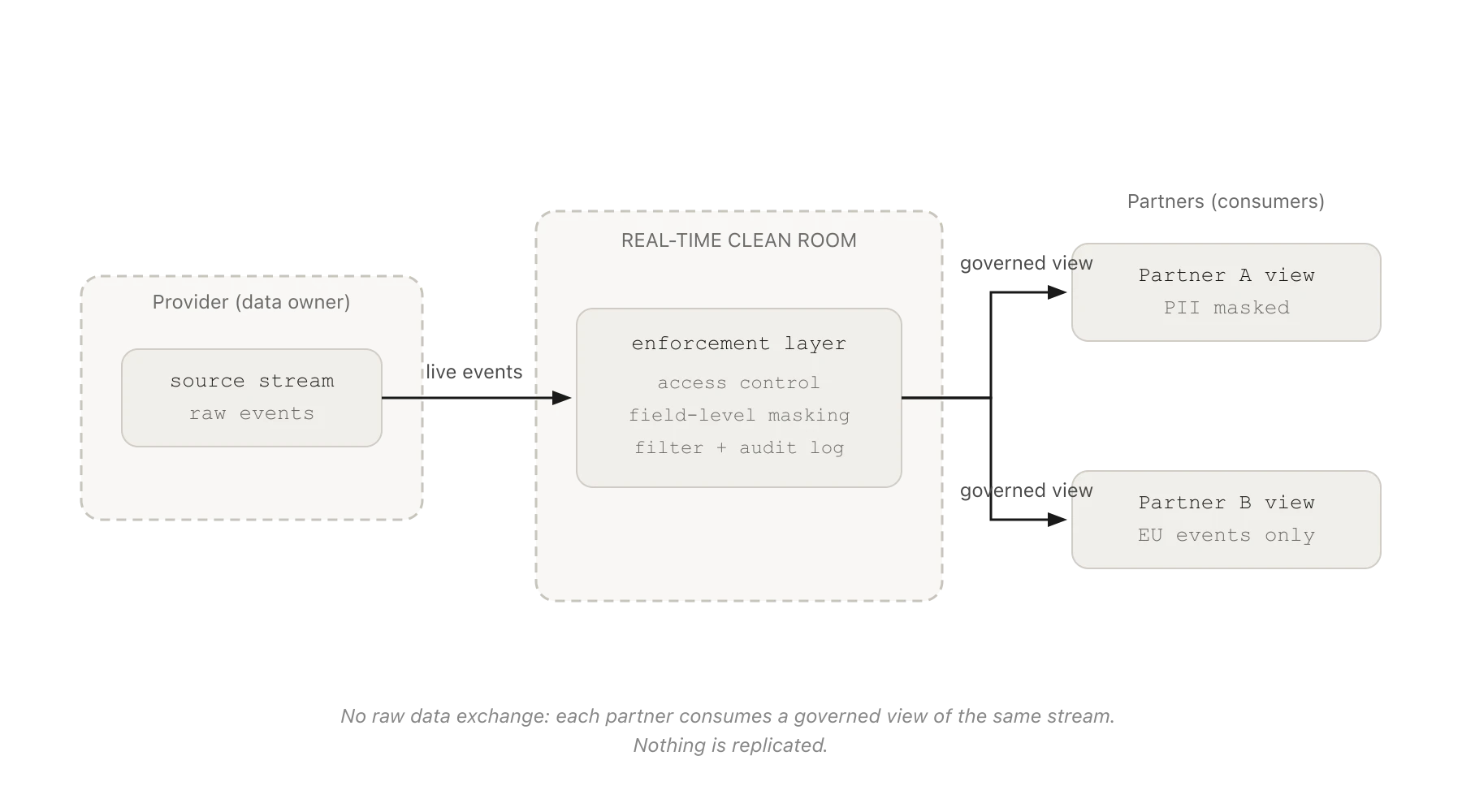
A real-time data clean room is a controlled environment where two or more organizations collaborate on live data streams without exposing the raw data behind them. It applies the core clean room guarantee, "you can use my data without seeing all of it", to events as they happen, through access control, field-level masking, and filtering enforced on the stream itself rather than on replicated tables.
What Is a Data Clean Room?
A data clean room is a secure environment where multiple parties bring data together for joint analysis while each party keeps control over what the others can see. A retailer and a brand can measure campaign overlap on their combined customer data, for example, without either side handing over its customer list.
The concept comes from advertising and analytics. Platforms such as AWS Clean Rooms, Snowflake Data Clean Rooms, and Google Ads Data Hub let participants run approved queries against joined datasets and receive only aggregated or policy-filtered results. These are mature, well-designed products for their purpose: collaborative analytics on datasets at rest.
Three properties define the category:
- No raw data exchange. Each party's data stays under its own governance. Collaborators query or consume a governed view, never the underlying records.
- Purpose-bound access. What a participant can see is defined by explicit policy: which fields, which rows, which aggregation levels.
- Auditability. Every access is logged, so each party can prove to regulators and to each other that the rules were followed.
How a Real-Time Clean Room Differs from a Batch Clean Room
Conventional data clean rooms operate on tables. Data is loaded, joined, and queried on a schedule, and the collaboration output is an analytical result: an overlap report, an attribution model, an aggregated segment. This works well when the question is analytical and the answer can wait for the next batch cycle.
A real-time data clean room applies the same guarantees to data in motion. Instead of governing queries over replicated tables, it governs consumption of live event streams, typically on a platform such as Apache Kafka. The differences follow from that:
| Dimension | Batch data clean room | Real-time data clean room |
|---|---|---|
| Data shape | Tables and datasets at rest | Live event streams |
| Data movement | Data is loaded or replicated into the collaboration environment | No copy; consumers read governed views of the source stream |
| Enforcement point | Query engine and result policies | Wire-level protocol filtering, masking, and access control |
| Output | Aggregated results, reports, model inputs | A continuous, policy-filtered stream per consumer |
| Latency | Batch or scheduled | Seconds or less, as events occur |
| Typical question | "What is our audience overlap?" | "Which of these events is this partner allowed to react to, right now?" |
Architecture of a Real-Time Data Clean Room
The defining component is an enforcement layer that sits between the data owner's streaming platform and each external consumer. In practice this is a protocol-aware proxy or gateway: consumers connect to it as if it were the streaming platform itself, and every policy is applied on the wire, before any byte reaches the partner.
Four capabilities make up the guarantee:
- Per-consumer identity and access control. Each partner authenticates as a distinct principal and is authorized for specific streams only. A partner cannot discover or read anything outside its granted scope.
- Field-level masking and encryption. Sensitive fields (names, account numbers, precise locations) are masked, tokenized, or encrypted per reader. Two partners consuming the same stream can receive two different projections of the same event.
- Row-level filtering. Events are filtered by content, so a partner receives only the records relevant to the relationship: its own SKUs, its own shipments, its own merchant category. The rest of the stream never leaves the boundary.
- Audit logging. Every connection, subscription, and read is recorded, giving the data owner a verifiable trail of exactly what each party consumed and when.
Because enforcement happens at the protocol layer, there is no replicated dataset to secure, reconcile, or delete later. The data owner keeps a single source of truth, and each partner sees a purpose-built view of it. This is the streaming counterpart of zero-copy data sharing: access without duplication.
For the building blocks, see data masking and anonymization for streaming, access control for streaming, and audit logging for streaming platforms.
Use Cases
- Retail media and brand partnerships. A retailer shares live purchase and inventory signals with brand advertisers. Each brand receives only events for its own products, with shopper identifiers masked, enabling real-time campaign activation without exposing the retailer's customer data or other brands' performance.
- Banking and fraud consortiums. Financial institutions exchange transaction signals to detect fraud patterns that no single bank can see alone. Field-level masking strips account holders' PII while preserving the attributes fraud models need, and audit logs document compliance with data-sharing agreements. See PII detection and handling in event streams.
- Logistics and supply chain visibility. A shipper streams tracking events to carriers, 3PLs, and retail partners. Each party sees only its own shipments in real time, with commercial fields such as order values filtered out, replacing daily file exchanges with a governed live feed.
These patterns extend the broader set of cross-organization data sharing patterns with clean-room-grade guarantees on the stream itself.
Honest Limits
The term "clean room" sets expectations that a real-time implementation only partly meets, so it is worth being precise:
- No secure multi-party computation. Analytical clean rooms can compute joint results (overlap counts, attribution) such that neither party sees the other's inputs. A real-time clean room does not compute over joined data; it governs what each consumer receives from a stream. If the collaboration question is "what does our combined data say?", a batch clean room is the right tool.
- No differential privacy or aggregation engine. Masking and filtering protect individual fields and records, but the output is still event-level data, not a privacy-budgeted aggregate.
- Trust concentrates in the enforcement layer. The guarantee is only as strong as the proxy's policy configuration and the network controls preventing consumers from bypassing it.
A more accurate framing: a real-time data clean room is governed real-time data sharing that delivers clean-room-style guarantees (no raw exposure, purpose-bound views, full audit) on streams. It complements analytical clean rooms rather than replacing them, and the same governed streams often feed those analytical environments downstream.
Implementing Real-Time Clean Room Controls
Wire-level enforcement of this kind is what streaming proxies are built for. Tools like Conduktor Gateway implement per-consumer masking, filtering, and audit at the Kafka protocol layer, with Partner Zones packaging these controls for external sharing. For a vendor-aware walkthrough of governed stream sharing, see real-time data sharing, and for how streaming-based sharing relates to table-based protocols such as Delta Sharing, see Delta Sharing alternatives for real-time data.
Related Concepts
- Zero-Copy Data Sharing - Sharing data through logical access instead of physical duplication
- Cross-Organization Data Sharing Patterns - Architectural patterns for sharing data across company boundaries
- Data Masking and Anonymization for Streaming - Field-level protection techniques for data in motion
- Access Control for Streaming - Authentication and authorization models for event streams
- Audit Logging for Streaming Platforms - Building the verifiable access trail clean rooms depend on
Sources and References
- AWS Clean Rooms Documentation - Collaborative analytics without sharing raw data
- Snowflake Data Clean Rooms - Clean room collaboration on the Snowflake platform
- IAB Tech Lab: Data Clean Rooms Guidance - Industry standards and definitions for clean room interoperability
- Delta Sharing Protocol - Open protocol for sharing tables without copying data
- Apache Kafka Documentation: Security - Authentication, authorization, and encryption primitives for streams